6th Class Maths Year Plan

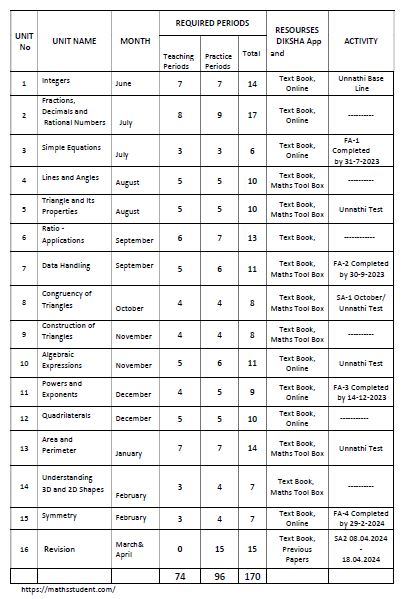
6th Class Maths Year Plan

YEAR PLAN  2023-2024
CLASS:-6TH EM
SUBJECT:MATHEMATICS
PERIODS REQUIRED:170
TEACHING PERIODS:75
PRACTICE PERIODS:95
MD.ZAHEER PASHA, SA (Maths), ZPSS KANDUKURU Vemsoor (md)
https://mathsstudent.com
LEARNING OUTCOMES
The learner—
Solves problems involving large numbers by applying appropriate operations (addition, subtraction, multiplication and division)
Recognises and appreciates (through patterns) the broad classification of numbers as even, odd, prime, co-prime, etc.
Applies HCF or LCM in a particular situation Solves problem involving addition and subtraction of integers.
Uses fractions and decimals in different situations which involve money, length, temperature etc. For example, 7½ metres of cloth. Distance between two places is 112.5 km etc.
Solves problems on daily life situations involving addition and subtraction of fractions / decimals
Uses variable with different operations to generalise a given situation. e.g., Perimeter of a rectangle with sides x units and 3 units is 2(x+3) units.
Compares quantities using ratios in different situations. e.g., the ratio of girls to boys in a particular class in 3:2
Uses unitary method in solving various word problems. For example, if the cost of a dozen notebooks is given she finds the cost of 7 notebooks by first finding the cost of 1 notebook.
Describes geometrical ideas like line, line segment, open and closed figures, angle, triangle, quadrilateral, circle, etc., with the help of examples in surroundings.
Demonstrates an understanding of angles by identifying examples of angles in the surroundings classifying angles according to their measure estimating the measure of angles demonstrates an understanding of line symmetry by identifying symmetrical 2-dimensional (2-D) shapes which are symmetrical along one or more lines creating symmetrical 2-D shapes.
Classifies triangles into different groups/ types on the basis of their angles and sides. For example- scalene, isosceles or equilateral on the basis of sides, etc.
Classifies quadrilaterals into different groups/types on the basis of their sides / angles. https://mathsstudent.com/        

CLICK HERE TO DOWNLOAD

CLICK HERE TO DOWNLOAD 6th Class Unit Plan

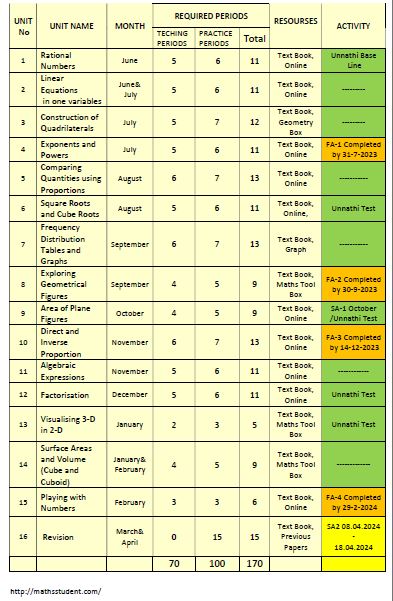
7th Class Maths Year Plan

7th Class Maths Year Plan

YEAR PLAN  2023-2024
CLASS:-7TH EM
SUBJECT:MATHEMATICS
PERIODS REQUIRED:170
TEACHING PERIODS:74
PRACTICE PERIODS:96
LEARNING OUTCOMES
The learner—
Multiplies/divides two integers
Interprets the division and multiplication of fractions
. For example interprets as of . Also is interpreted as how many make ?
Uses algorithms to multiply and divide fractions/decimals.
Solves problems related to daily life situations involving rational numbers
Uses exponential form of numbers to simplify problems involving multiplication and division of large numbers
. Represents daily life situations in the form of a simple equation and solves it
Adds/subtracts algebraic expressions Distinguishes quantities that are in proportion. For example, tells that 15, 45, 40, 120 are in proportion as is the same as
Solves problems related to conversion of percentage to fraction and decimal and vice versa
Caculates profit/loss percent and rate percent in simple interest
Classifies pairs of angles based on their properties as linear, supplementary,complementary, adjacent and vertically opposite and finds value of the one when the other is given.
Verifies the properties of various pairs of angles formed when a transversal cuts Two lines
Finds unknown angle of a triangle when its two angles are known
Explains congruency of triangles on the basis of the information given about them like (SSS, SAS, ASA, RHS)
Using ruler and a pair of compasses constructs, a line parallel to a given line from a point outside it and triangles finds out approximate area of closed shapes by using unit square grid/ graph sheet
Calculates areas of the regions enclosed in a rectangle and a square
Finds various representative values for simple data from her/his daily life contexts like mean, median and mode
Recognises variability in real life situation such as, variations in the height of students in her class and uncertainty in happening of events like throwing a coin.
This image has an empty alt attribute; its file name is 7th-Class-year-Plan.jpg

Click Here to Download

CLICK HERE to DOWNLOAD 7th Unit Plan

8th Class Maths Year Plan

8th Class Maths Year Plan

YEAR PLAN  2023-2024
CLASS:-8TH EM
SUBJECT:MATHEMATICS
PERIODS REQUIRED:170
TEACHING PERIODS:70
PRACTICE PERIODS:100
LEARNING OUTCOMES
The learner —
Generalises properties of addition, subtraction, multiplication and division of rational
numbers through patterns
Finds out as many rational numbers as possible between two given rational numbers.
Proves divisibility rules of 2, 3,4, 5, 6, 9 and 11
Finds squares, cubes and square roots and cube roots of numbers using different
methods.
Solves problems with integral exponents.
Solves puzzles and daily life problems using variables.
Multiplies algebraic expressions. e.g expands (2x-5)(3×2+7).
Uses various algebric identities in solving problems of daily life
Applies the concept of per cent in profit and loss situation in finding discount, VAT  and compound interest. e.g., calculates discount per cent when marked price and actual discount are given or finds profit per cent when cost price and profit in a transaction are given.
Solves problems based on direct and inverse proportions
Solves problems related to angles of a quadrilateral using angle sum property
Verifies properties of parallelograms and establishes the relationship between them through reasoning.
Represents 3D shapes on a plane surface such as sheet of paper, black board etc.
Verifies Euler’s relation through pattern
Constructs different quadrilaterals using compasses and straight edge.
Estimates the area of shapes like trapezium and other polygons by using square grid/graph sheet and verifies using formulas.
Finds the area of a polygon.
Finds surface area and volume of cuboidal and cylindrical object.
Draws and interprets bar charts and pie charts.
Makes hypotheses on chances of future events on the basis of its earlier occurrences or available data like , after repeated throws of dice and coins.

Download 8th EM YEAR PLAN

CLICK HERE to DOWNLOAD 8th Class Maths Unit Plan

Unnathi Reports and Module

Unnathi Reports and Module

Download Unnathi Reports and Module

UNNATHI MONTHLY TEST FORM

UNNATH IBASIC SKILLS CONSOLIDATE REPORT

UNNATHI SUBJECT SKILLS CONSOLIDATE REPORT

LAKSHYA MATHS MODULE

UNNATHI MATHS MODULE

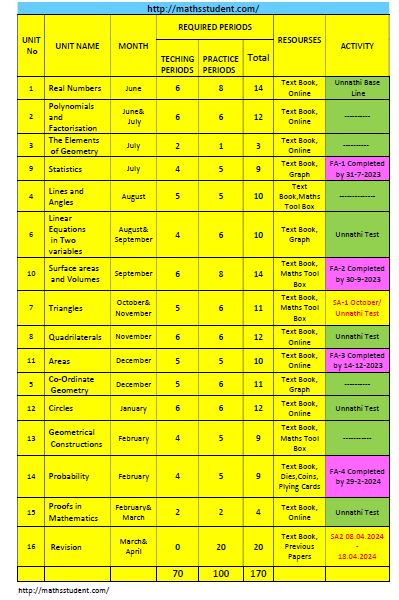
9th Class Maths Year Plan

9th Class Maths Year Plan

CLASS:-9TH EM
SUBJECT:MATHEMATICS
PERIODS REQUIRED:170
TEACHING PERIODS:70
PRACTICE PERIODS:100
LEARNING OUTCOMES
The learner —
• Applies logical reasoning in classifying real numbers, proving their properties and using them in different situations.
• Identifies/classifies polynomials among algebraic expressions and factorises them by
applying appropriate algebraic identities.
• Relates the algebraic and graphical representations of a linear equation in one or two variables and applies the concept to daily life situations.
• Identifies similarities and differences among different geometrical shapes.
• Derives proofs of mathematical statements particularly related to geometrical concepts, like parallel lines, triangles, quadrilaterals, circles, etc., by applying axiomatic approach and solves problems using them.
• Finds areas of all types of triangles by using appropriate formulae and apply them in real life situations.
• Constructs different geometrical shapes like bisectors of line segments, angles and triangles under given conditions and provides reasons for the processes of such constructions.
• Develops strategies to locate points in a Cartesian plane.
• Identifies and classifies the daily life situations in which mean, median and mode can be used.
• Analyses data by representing it in different forms like, tabular form (grouped or
ungrouped), bar graph, histogram (with equal and varying width and length), and frequency polygon.
• Calculates empirical probability through experiments and describes its use in words.
• Derives formulae for surface areas and volumes of different solid objects like,
cubes, cuboids, right circular cylinders/ cones, spheres and hemispheres and applies
them to objects found in the surroundings.
• Solves problems that are not in the familiar context of the child using above learning. These problems should include the situations to which the child is not exposed earlier        

Click Here to Download

CLICK HERE DOWNLOAD 9th Class Maths Unit Plan

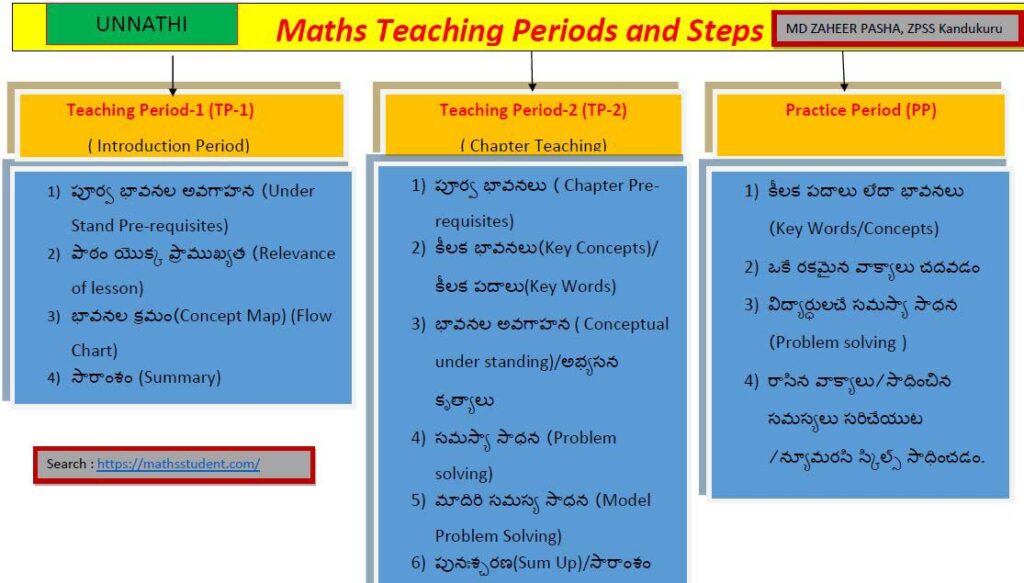
UNNATHI Maths Teaching Periods and Steps     

UNNATHI Maths Teaching Periods and Steps 

 Teaching Period-1 (TP-1)( Introduction Period)

  1. పూర్వ భావనల అవగాహన (Under Stand Pre-requisites)
  2. పాఠం యొక్క ప్రాముఖ్యత (Relevance of lesson)
  3. భావనల క్రమం(Concept Map) (Flow Chart)
  4. సారాంశం (Summary)   

Teaching Period-2 (TP-2) ( Chapter Teaching)

  1. పూర్వ భావనలు ( Chapter Pre-requisites)
  2. కీలక భావనలు(Key Concepts)/  కీలక పదాలు(Key Words)
  3. భావనల అవగాహన ( Conceptual under standing)/అభ్యసన కృత్యాలు
  4. సమస్యా సాధన (Problem solving)
  5. మాదిరి సమస్య సాధన (Model Problem Solving)
  6. పునఃశ్చరణ(Sum Up)/సారాంశం

Practice Period (PP)

  1. కీలక పదాలు లేదా భావనలు (Key Words/Concepts)
  2. ఒకే రూప వాక్యాలు/ఒకే రకమైన వాక్యాలు చదవడం
  3. విద్యార్ధులచే సమస్యా సాధన (Problem solving )
  4. రాసిన వాక్యాలు/సాధించిన సమస్యలు సరిచేయుట /న్యూమరసి స్కిల్స్ సాధించడం