These solutions are based on the Telangana State Class X Mathematics textbook, focusing on set operations. Mathematical expressions are rendered using MathJax.
1. If A = {1, 2, 3, 4} and B = {1, 2, 3, 5, 6}, then find A ∩ B and B ∩ A. Are they equal?
A ∩ B = {x : x ∈ A and x ∈ B} = {1, 2, 3}.
B ∩ A = {x : x ∈ B and x ∈ A} = {1, 2, 3}.
Since A ∩ B = B ∩ A, they are equal.
A ∩ B = {1, 2, 3}, B ∩ A = {1, 2, 3}, Equal: Yes
2. If A = {0, 2, 4}, find A ∩ φ and A ∩ A. Comment.
A ∩ φ = {x : x ∈ A and x ∈ φ} = φ (empty set).
A ∩ A = {x : x ∈ A and x ∈ A} = {0, 2, 4}.
Comment: A ∩ φ is always the empty set, and A ∩ A is the set itself.
A ∩ φ = φ, A ∩ A = {0, 2, 4}
3. If A = {2, 4, 6, 8, 10} and B = {3, 6, 9, 12, 15}, find A – B and B – A.
A – B = {x : x ∈ A and x ∉ B} = {2, 4, 8, 10}.
B – A = {x : x ∈ B and x ∉ A} = {3, 9, 12, 15}.
A – B = {2, 4, 8, 10}, B – A = {3, 9, 12, 15}
4. If A and B are two sets such that A ⊆ B then what is A ∪ B?
If A ⊆ B, every element of A is in B.
A ∪ B = {x : x ∈ A or x ∈ B} = B (since A is a subset of B).
A ∪ B = B
5. Let A = {x : x is a natural number}, B = {x : x is an even natural number}, C = {x : x is an odd natural number} and D = {x : x is a prime number}. Find A ∩ B, A ∩ C, A ∩ D, B ∩ C, B ∩ D and C ∩ D.
A = {1, 2, 3, …}, B = {2, 4, 6, …}, C = {1, 3, 5, …}, D = {2, 3, 5, 7, …}.
A ∩ B = {x : x ∈ A and x ∈ B} = {2, 4, 6, …} = B.
A ∩ C = {x : x ∈ A and x ∈ C} = {1, 3, 5, …} = C.
A ∩ D = {x : x ∈ A and x ∈ D} = {2, 3, 5, 7, …} = D.
B ∩ C = {x : x ∈ B and x ∈ C} = φ (no number is both even and odd).
B ∩ D = {x : x ∈ B and x ∈ D} = {2} (only 2 is even and prime).
C ∩ D = {x : x ∈ C and x ∈ D} = {3, 5, 7, …} (odd primes).
A ∩ B = {2, 4, 6, …}, A ∩ C = {1, 3, 5, …}, A ∩ D = {2, 3, 5, 7, …}, B ∩ C = φ, B ∩ D = {2}, C ∩ D = {3, 5, 7, …}
6. If A = {3, 6, 9, 12, 15, 18, 21}, B = {4, 8, 12, 16, 20}, C = {2, 4, 6, 8, 10, 12, 14, 16} and D = {5, 10, 15, 20}, find (i) A – B (ii) A – C (iii) A – D (iv) B – A (v) C – A (vi) B – D (vii) B – C (viii) C – B (ix) C – D (x) D – B.
A = {3, 6, 9, 12, 15, 18, 21}, B = {4, 8, 12, 16, 20}, C = {2, 4, 6, 8, 10, 12, 14, 16}, D = {5, 10, 15, 20}.
A – B = {3, 6, 9, 15, 18, 21} (exclude 12).
A – C = {3, 9, 15, 18, 21} (exclude 6, 12).
A – D = {3, 6, 9, 12, 18, 21} (exclude 15).
B – A = {4, 8, 16, 20} (exclude 12).
C – A = {2, 4, 8, 10, 14, 16} (exclude 6, 12).
B – D = {4, 8, 12, 16} (exclude 20).
C – B = {2, 6, 10, 14} (exclude 4, 8, 12, 16, 20).
C – D = {2, 4, 6, 8, 12, 14, 16} (exclude 10, 20).
D – B = {5, 10, 15} (exclude 20).
(i) A – B = {3, 6, 9, 15, 18, 21}, (ii) A – C = {3, 9, 15, 18, 21}, (iii) A – D = {3, 6, 9, 12, 18, 21}, (iv) B – A = {4, 8, 16, 20}, (v) C – A = {2, 4, 8, 10, 14, 16}, (vi) B – D = {4, 8, 12, 16}, (vii) B – C = {}, (viii) C – B = {2, 6, 10, 14}, (ix) C – D = {2, 4, 6, 8, 12, 14, 16}, (x) D – B = {5, 10, 15}
7. State whether each of the following statements is true or false. Justify your answers.
(i) {2, 3, 4, 5} and {3, 6} are disjoint sets.
Common element: 3.
Not disjoint as they share 3.
Conclusion:False
(ii) {a, e, i, o, u} and {a, b, c, d} are disjoint sets.
Common element: a.
Not disjoint as they share a.
Conclusion:False
(iii) {2, 6, 10, 14} and {3, 7, 11, 15} are disjoint sets.
These solutions are based on the Telangana State Class X Mathematics textbook, focusing on set theory concepts. Mathematical expressions are rendered using MathJax.
1. Which of the following are sets? Justify your answer.
(i) The collection of all the months of a year beginning with the letter “J”.
List: January, June, July.
Well-defined collection with clear membership.
Conclusion: This is a set.
(ii) The collection of ten most talented writers of India.
Membership depends on subjective judgment of “most talented.”
Not well-defined.
Conclusion: This is not a set.
(iii) A team of eleven best cricket batsmen of the world.
Membership depends on subjective “best” criterion.
Not well-defined.
Conclusion: This is not a set.
(iv) The collection of all boys in your class.
Clear membership based on objective class enrollment.
Well-defined collection.
Conclusion: This is a set.
(v) The collection of all even integers.
Clear membership (integers divisible by 2).
Well-defined collection.
Conclusion: This is a set.
2. If A = {0, 2, 4, 6}, B = {3, 5, 7} and C = {p, q, r}, then fill the appropriate symbol, \( \in \) or \( \notin \) in the blanks.
(i) 0 … A
0 is an element of A.
Symbol = \(\in\)
(ii) 3 … C
3 is not an element of C.
Symbol = \(\notin\)
(iii) 4 … B
4 is not an element of B.
Symbol = \(\notin\)
(iv) p … C
p is an element of C.
Symbol = \(\in\)
(v) 7 … B
7 is an element of B.
Symbol = \(\in\)
(vi) 7 … A
7 is not an element of A.
Symbol = \(\notin\)
3. Express the following statements using symbols.
(i) The element \( x \) does not belong to \( A \).
Symbol = \( x \notin A \)
(ii) \( d \) is an element of the set \( B \).
Symbol = \( d \in B \)
(iii) \( 1 \) belongs to the set of Natural numbers.
Symbol = \( 1 \in \mathbb{N} \)
(iv) \( 8 \) does not belong to the set of prime numbers \( P \).
Symbol = \( 8 \notin P \)
4. State whether the following statements are true or false. Justify your answer.
(i) 5 \( \in \) set of prime numbers
5 is a prime number (divisible only by 1 and itself).
Conclusion:True
(ii) S = {5, 6, 7} implies 8 \( \in \) S.
S contains {5, 6, 7}, and 8 is not in S.
Conclusion:False
(iii) -5 \( \in \) \( \mathbb{W} \) where \( \mathbb{W} \) is the set of whole numbers.
Whole numbers are {0, 1, 2, …}, and -5 is not included.
Conclusion:False
(iv) \( \frac{11}{2} \in \mathbb{Z} \) where \( \mathbb{Z} \) is the set of integers.
Integers are {…, -2, -1, 0, 1, 2, …}, and \( \frac{11}{2} = 5.5 \) is not an integer.
Conclusion:False
5. Write the following sets in roster form.
(i) B = {x : x is a natural number smaller than 6}
Natural numbers: 1, 2, 3, 4, 5.
Roster form = {1, 2, 3, 4, 5}
(ii) C = {x : x is a two-digit natural number such that the sum of its digits is 8}
Two-digit numbers with digit sum 8: 17, 26, 35, 44, 53, 62, 71, 80.
Roster form = {17, 26, 35, 44, 53, 62, 71, 80}
(iii) D = {x : x is a prime number which is a divisor of 60}
Prime factors of 60 = 2 × 2 × 3 × 5: 2, 3, 5.
Roster form = {2, 3, 5}
(iv) E = {x : x is an alphabet in BETTER}
Unique letters in “BETTER”: B, E, T, R.
Roster form = {B, E, T, R}
6. Write the following sets in the set-builder form.
(i) {3, 6, 9, 12}
Common property: Multiples of 3.
Set-builder form = {x : x is a multiple of 3 and \( x \leq 12 \)}
(ii) {2, 4, 8, 16, 32}
Common property: Powers of 2 up to 32.
Set-builder form = {x : x = 2^n, n is a natural number and \( x \leq 32 \)}
(iii) {5, 25, 125, 625}
Common property: Powers of 5.
Set-builder form = {x : x = 5^n, n is a natural number and \( x \leq 625 \)}
(iv) {1, 4, 9, 16, 25, …, 100}
Common property: Perfect squares up to 100.
Set-builder form = {x : x = n^2, n is a natural number and \( x \leq 100 \)}
7. Write the following sets in roster form.
(i) A = {x : x is a natural number greater than 50 but smaller than 100}
Natural numbers from 51 to 99.
Roster form = {51, 52, 53, …, 99}
(ii) B = {x : x is an integer, \( x^2 < 4 \)}
\( x^2 < 4 \) implies \( -2 < x < 2 \).
Integers in range: -1, 0, 1.
Roster form = {-1, 0, 1}
(iii) D = {x : x is a letter in the word “LOYAL”}
Unique letters in “LOYAL”: L, O, Y, A.
Roster form = {L, O, Y, A}
8. Match the roster form with set-builder form.
(i) {1, 2, 3, 6}
Elements are prime numbers and divisors of 6 (2, 3) plus 1, 6.
Matches: {x : x is a prime number and a divisor of 6}.
Match = (a)
(ii) {2, 3}
Elements are prime numbers and divisors of 6.
Matches: {x : x is a natural number and divisor of 6} (subset with 2, 3).
Match = (c)
(iii) {m, a, t, h, e, i, c, s}
Elements are letters of “MATHEMATICS”.
Matches: {x : x is a letter of the word MATHEMATICS}.
Match = (d)
(iv) {1, 3, 5, 7, 9}
Elements are odd natural numbers smaller than 10.
Matches: {x : x is an odd natural number smaller than 10}.
These solutions are based on the Telangana State Class X Mathematics textbook, focusing on logarithmic expressions and evaluations. Mathematical expressions are rendered using MathJax.
1. Determine the value of the following.
(i) \( \log_2 5 \)
Cannot be simplified to an exact integer value directly.
Approximate value depends on log tables or calculator: \( \log_2 5 \approx 2.322 \).
Value = \( \log_2 5 \approx 2.322 \) (approximate)
(i) \( \log 2 \) rational or irrational? Justify your answer.
\( \log 2 \) is the exponent to which 10 must be raised to get 2.
It is known that \( \log 2 \) is irrational because 2 is not a power of 10 with an integer exponent.
Proof by contradiction: If \( \log 2 = \frac{p}{q} \), then \( 10^{p/q} = 2 \), \( 10^p = 2^q \), leading to a contradiction as 10 and 2 have different prime factors.
Conclusion: \( \log 2 \) is irrational.
(ii) \( \log 100 \) rational or irrational? Justify your answer.
These solutions are based on the Telangana State Class X Mathematics textbook, focusing on proving irrational numbers. Mathematical expressions are rendered using MathJax.
1. Prove that the following are irrational.
(i) \( \frac{1}{\sqrt{2}} \)
Assume \( \frac{1}{\sqrt{2}} \) is rational, i.e., \( \frac{1}{\sqrt{2}} = \frac{a}{b} \), where \( a \) and \( b \) are co-prime integers, \( b \neq 0 \).
Then, \( \sqrt{2} = \frac{b}{a} \).
Square both sides: \( 2 = \frac{b^2}{a^2} \), so \( b^2 = 2a^2 \).
\( b^2 \) is even, so \( b \) is even. Let \( b = 2c \).
\( a^2 \) is even, so \( a \) is even, contradicting co-primality.
Thus, \( \frac{1}{\sqrt{2}} \) is irrational.
Conclusion: \( \frac{1}{\sqrt{2}} \) is irrational.
(ii) \( \sqrt{3} + \sqrt{5} \)
Assume \( \sqrt{3} + \sqrt{5} \) is rational, i.e., \( \sqrt{3} + \sqrt{5} = \frac{a}{b} \), where \( a \) and \( b \) are co-prime integers, \( b \neq 0 \).
Square both sides: \( (\sqrt{3} + \sqrt{5})^2 = \frac{a^2}{b^2} \).
Square both sides: \( 2 = \frac{(a – 6b)^2}{b^2} \), so \( (a – 6b)^2 = 2b^2 \).
Left side integer, right side \( 2b^2 \) (even if \( b \) is odd), but \( a – 6b \) must be even, leading to \( a \) and \( b \) both even, contradicting co-primality.
Thus, \( 6 + \sqrt{2} \) is irrational.
Conclusion: \( 6 + \sqrt{2} \) is irrational.
(iv) \( \sqrt{5} \)
Assume \( \sqrt{5} \) is rational, i.e., \( \sqrt{5} = \frac{a}{b} \), where \( a \) and \( b \) are co-prime integers, \( b \neq 0 \).
Square both sides: \( 5 = \frac{a^2}{b^2} \), so \( a^2 = 5b^2 \).
\( a^2 \) is multiple of 5, so \( a \) is multiple of 5. Let \( a = 5c \).
Square both sides: \( 5 = \frac{(a – 3b)^2}{4b^2} \), so \( 20b^2 = (a – 3b)^2 \).
Left side even, right side must be even, implying \( a – 3b \) even, leading to \( a \) and \( b \) both even, contradicting co-primality.
Thus, \( 3 + 2\sqrt{5} \) is irrational.
Conclusion: \( 3 + 2\sqrt{5} \) is irrational.
2. Prove that \( \sqrt{p} + \sqrt{q} \) is irrational, where \( p, q \) are primes.
Assume \( \sqrt{p} + \sqrt{q} \) is rational, i.e., \( \sqrt{p} + \sqrt{q} = \frac{a}{b} \), where \( a \) and \( b \) are co-prime integers, \( b \neq 0 \), and \( p, q \) are distinct primes.
Square both sides: \( (\sqrt{p} + \sqrt{q})^2 = \frac{a^2}{b^2} \).
\( p + q + 2\sqrt{pq} = \frac{a^2}{b^2} \), so \( 2\sqrt{pq} = \frac{a^2}{b^2} – p – q \), \( \sqrt{pq} = \frac{a^2 – b^2(p + q)}{2b^2} \).
Left side \( \sqrt{pq} \) (where \( pq \) is not a perfect square since \( p \neq q \)) is irrational, but right side is rational, a contradiction.
Thus, \( \sqrt{p} + \sqrt{q} \) is irrational.
Conclusion: \( \sqrt{p} + \sqrt{q} \) is irrational when \( p, q \) are primes.
These solutions are based on the Telangana State Class X Mathematics textbook, focusing on decimal expansions and rational numbers. Mathematical expressions are rendered using MathJax.
1. Write the following rational numbers in their decimal form and also state which are terminating and which are non-terminating, repeating decimal.
Denominator \( 125 = 5^3 \), only 5, so terminating.
Decimal = 0.064, Terminating
2. Without performing division, state whether the following rational numbers will have a terminating decimal form or a non-terminating, repeating decimal form.
A rational number \( \frac{p}{q} \) (in lowest form) has a terminating decimal if \( q = 2^m \times 5^n \), where \( m \) and \( n \) are non-negative integers.
These solutions are based on the Telangana State Class X Mathematics textbook, focusing on the Fundamental Theorem of Arithmetic. Mathematical expressions are rendered using MathJax.
1. Express each of the following numbers as a product of its prime factors.
These solutions are based on the Telangana State Class X Mathematics textbook, focusing on Euclid’s algorithm and the division algorithm. Mathematical expressions are rendered using MathJax.
1. Use Euclid’s algorithm to find the HCF of:
Euclid’s algorithm: For two positive integers \(a\) and \(b\) (where \(a > b\)), divide \(a\) by \(b\), take the remainder, and repeat until the remainder is 0. The last non-zero remainder is the HCF.
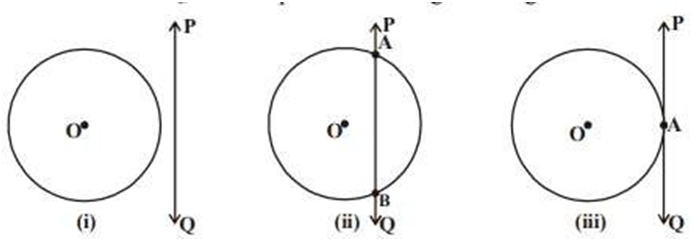
The line PQ and the circle have no common point. In this case PQ is a nonintersecting line with respect to the circle.
The line PQ intersects the circle at two points A and B. It forms a chord AB on the circle with two common points. In this case the line PQ is a secant of the circle.
There is only one point A, common to the line PQ and the circle. This line is called a tangent to the circle.
The common point of the tangent and the circle is called the point of contact and the tangent is said to touch the circle at the common point.
We can draw infinite tangents to the circle.
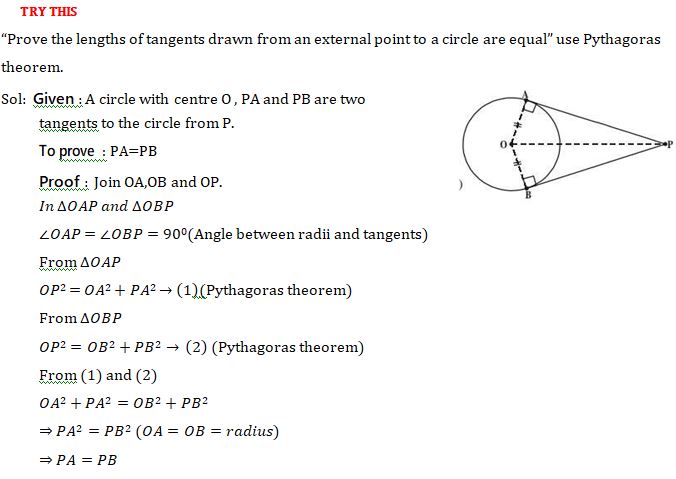
We can draw two tangents to the circle from a point away from it.
The tangent at any point of a circle is perpendicular to the radius through the point of contact.
EXERCISE-9.I
Fill in the blanks
i) A tangent to a circle intersects it in ….one………… point (s).
ii) A line intersecting a circle in two points is called a………secant……
iii) The number of tangents drawn at the end points of the diameter is……. two…….
iv) The common point of a tangent to a circle and the circle is called ……. point of contact…..
v) We can draw…. infinite….. tangents to a given circle.
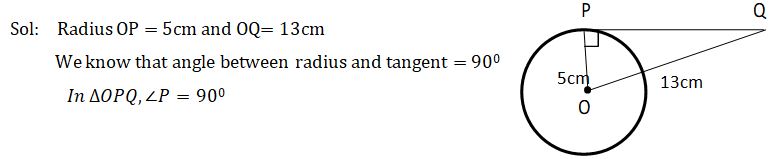
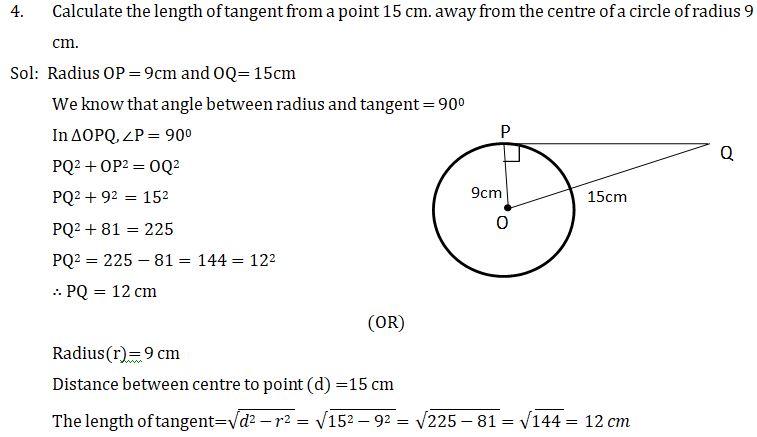
A tangent PQ at a point P of a circle of radius 5 cm meets a line through the centre O at a point Q so that OQ = 13 cm. Find length of PQ.
𝑃𝑄2 + 𝑂𝑃2 = 𝑂𝑄2
𝑃𝑄2 + 52 = 132
𝑃𝑄2 + 25 = 169
𝑃𝑄2 = 169 − 25 = 144 = 122
∴ 𝑃𝑄 = 12 𝑐𝑚
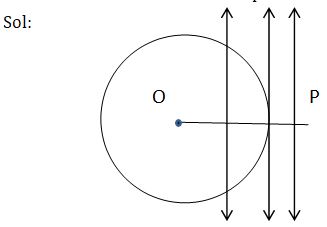
3. Draw a circle and two lines parallel to a given line such that one is a tangent and the other, a secant to the circle.
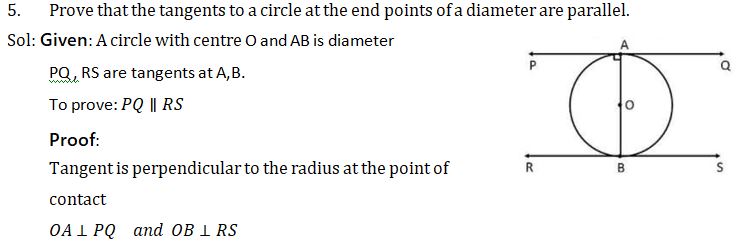
∠𝑂𝐴𝑃 = 900 𝑎𝑛d ∠𝑂𝐵𝑆 = 900
⇒ ∠𝐵𝐴𝑃 = 900 𝑎𝑛𝑑 ∠𝐴𝐵𝑆 = 900
⇒ ∠𝐵𝐴𝑃 = ∠𝐴𝐵𝑆
⇒ 𝐴𝑙𝑡𝑒𝑟𝑛𝑎𝑡𝑒 𝑖𝑛𝑡𝑒𝑟𝑖𝑜𝑟 𝑎𝑛𝑔𝑙𝑒𝑠 𝑎𝑟𝑒 𝑒𝑞𝑢𝑎𝑙
⇒ 𝑃𝑄 ∥ 𝑅𝑆
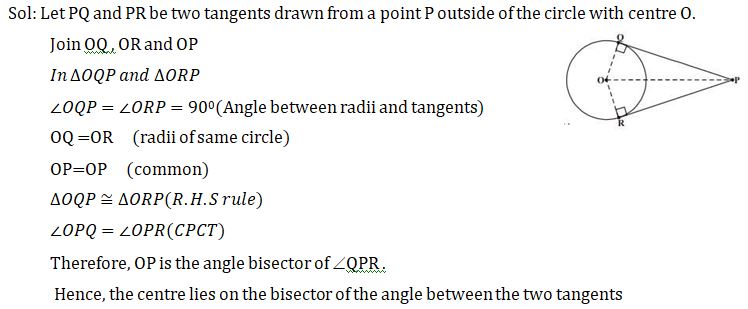
Prob1:Prove The centre of a circle lies on the bisector of the angle between two tangents drawn from a point outside it.
Standard form of quadratic equation in variable 𝑥 is 𝒂𝒙𝟐 + 𝒃𝒙 + 𝒄 = 𝟎, where 𝑎, 𝑏, 𝑐 are real numbers and 𝑎 ≠ 0.
y = 𝑎𝑥2+ 𝑏𝑥 + 𝑐 is called a quadratic function.
Uses of Quadratic functions. (i) When the rocket is fired upward, then the path of the rocket is defined by a ‘quadratic function.’ (ii) Shapes of the satellite dish, reflecting mirror in a telescope, lens of the eye glasses and orbits of the celestial objects are defined by the quadratic equations. (iii) The path of a projectile is defined by quadratic function. (iv) When the breaks are applied to a vehicle, the stopping distance is calculated by using quadratic equation
Roots of quadratic equation: A real number 𝛼 is called a root of the quadratic equation 𝑎𝑥2 + 𝑏𝑥 + 𝑐 = 0, if 𝑎𝛼2 + 𝑏𝛼 + 𝑐 = 0
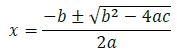
Quadratic formula: The roots of a quadratic equation 𝑎𝑥2 + 𝑏𝑥 + 𝑐 = 0 are given by
Nature of roots: The nature of roots of a quadratic equation 𝑎𝑥2 + 𝑏𝑥 + 𝑐 = 0 depends on 𝑏2 − 4𝑎𝑐 is called the discriminant (i) 𝐼𝑓 𝒃𝟐 − 𝟒𝒂𝒄 > 𝟎 𝑡ℎ𝑒𝑛 𝑡ℎ𝑒 𝑟𝑜𝑜𝑡𝑠 𝑎𝑟𝑒 𝑟𝑒𝑎𝑙 𝑎𝑛𝑑 𝑑𝑖𝑠𝑡𝑖𝑛𝑐𝑡 (ii) 𝐼𝑓 𝒃𝟐 − 𝟒𝒂𝒄 = 𝟎 𝑡ℎ𝑒𝑛 𝑡ℎ𝑒 𝑟𝑜𝑜𝑡𝑠 𝑎𝑟𝑒 𝑟𝑒𝑎𝑙 𝑎𝑛𝑑 𝑒𝑞𝑢𝑎𝑙 (iii) 𝐼𝑓 𝒃𝟐 − 𝟒𝒂𝒄 < 𝟎 𝑡ℎ𝑒𝑛 𝑡ℎ𝑒 𝑟𝑜𝑜𝑡𝑠 𝑎𝑟𝑒 𝑛𝑜𝑡 𝑟𝑒𝑎𝑙
Try This
Check whether the following equations are quadratic or not ? (i) 𝑥 2– 6𝑥 – 4 = 0 Sol: Quadratic equation
(ii) 𝑥 3– 6𝑥 2 + 2𝑥 -1 = 0 Sol: Not a quadratic equation(Cubic equation)
(vi) 3y2 = 192 Sol: 3y2 – 192=0 This is a quadratic equation
Example-1.
i. Raju and Rajendar together have 45 marbles. Both of them lost 5 marbles each, and the product of the number of marbles now they have is 124. We would like to find out how many marbles they had previously. Represent the situation mathematically. Sol: Total marbles=45 Let the number of marbles at Raju = 𝑥 Then the number of marbles at Rajendar = 45 − 𝑥 If both of them lost 5 marbles each then The number of marbles at Raju = 𝑥 − 5 The number of marbles at Rajendar = 45 − 𝑥 − 5 = 40 − 𝑥 The product of remaining marbles=124 ⇒ (𝑥 − 5)(40 − 𝑥) = 124 ⇒ 40𝑥 − 𝑥2 − 200 + 5𝑥 = 124 ⇒ −𝑥2 + 45𝑥 − 200 − 124 = 0 ⇒ −𝑥2 + 45𝑥 − 324 = 0 ⇒ 𝑥2 − 45𝑥 + 324 = 0 (multiply with −1)
ii. The hypotenuse of a right triangle is 25 cm. We know that the difference in lengths of the other two sides is 5 cm. We would like to find out the length of the two sides?
Sol: Let the length of smaller side = 𝑥 𝑐𝑚 The length of larger side = (𝑥 + 5)𝑐𝑚 Length of hypotenuse = 25 𝑐𝑚 In a right angle triangle we know that (𝑠𝑖𝑑𝑒)2 + (𝑠𝑖𝑑𝑒)2 = (ℎ𝑦𝑝𝑜𝑡𝑒𝑛𝑢𝑠𝑒)2 (𝑥)2 + (𝑥 + 5)2 = (25)2 𝑥2 + 𝑥2 + 2 × 𝑥 × 5 + 52 = 625 2𝑥2 + 10𝑥 + 25 − 625 = 0 2𝑥2 + 10𝑥 + −600 = 0 𝑥2 + 5𝑥 − 300 = 0 Required quadratic equation: 𝑥2 + 5𝑥 − 300
Example-2. Check whether the following are quadratic equations: i. (𝑥 − 2)2 + 1 = 2𝑥 − 3 Sol: (𝑥 − 2)2 + 1 = 2𝑥 − 3 ⇒ 𝑥2 − 4𝑥 + 4 + 1 − 2𝑥 + 3 = 0 ⇒ 𝑥2 − 6𝑥 + 8 = 0 The given equation is a quadratic equation.
ii. 𝑥(𝑥 + 1) + 8 = (𝑥 + 2)(𝑥 − 2) Sol: 𝑥(𝑥 + 1) + 8 = (𝑥 + 2)(𝑥 − 2) ⇒ 𝑥2 + 𝑥 + 8 = 𝑥2 − 22 ⇒ 𝑥2 + 𝑥 + 8 − 𝑥2 + 4 = 0 ⇒ 𝑥 + 12 = 0 The given equation is not a quadratic equation.
iii. 𝑥(2𝑥 + 3) = 𝑥2 + 1 Sol: 𝑥(2𝑥 + 3) = 𝑥2 + 1 ⇒ 2𝑥2 + 3𝑥 − 𝑥2 − 1 = 0 ⇒ 𝑥2 + 3𝑥 − 1 = 0 The given equation is a quadratic equation
i. The area of a rectangular plot is 528 m2 . The length of the plot (in metres) is one more than twice its breadth. We need to find the length and breadth of the plot. Sol: Let breadth of rectangular plot (𝑏) = 𝑥 𝑚 Length of rectangular plot (𝑙) = (2𝑥 + 1)𝑚 Given area of the rectangular plot = 528 𝑚2 𝑙 × 𝑏 = 528 (2𝑥 + 1) × 𝑥 = 528 2𝑥2 + 𝑥 − 528 = 0 This is the required quadratic equation. ii. The product of two consecutive positive integers is 306. We need to find the integers. Sol: Let the two consecutive positive integers be 𝑥 , 𝑥 + 1 Given the product of two consecutive positive integers = 306 𝑥 × (𝑥 + 1) = 306 ⟹ 𝑥2 + 𝑥 − 306 = 0 This is the required quadratic equation iii. Rohan’s mother is 26 years older than him. The product of their ages after 3 years will be 360 years. We need to find Rohan’s present age. Sol: Let Rohan’s age=𝑥 years Rohan’s mother age=(𝑥 + 26)𝑦𝑒𝑎𝑟𝑠 After 3 years Rohan’s age=𝑥 + 3 years Rohan’s mother age=(𝑥 + 26 + 3) = (𝑥 + 29)𝑦𝑒𝑎𝑟𝑠 Given the product of their ages after 3 years=360 years ⇒ (𝑥 + 3)(𝑥 + 29) = 360 ⇒ 𝑥2 + 29𝑥 + 3𝑥 + 87 − 360 = 0 ⇒ 𝑥2 + 32𝑥 − 273 = 0 This is the required quadratic equation.
iv. A train travels a distance of 480 km at a uniform speed. If the speed had been 8 km/h less, then it would have taken 3 hours more to cover the same distance. We need to find the speed of the train. Sol: Let the speed of the train= 𝑥 𝑘𝑚/ℎ Distance= 480 km 𝑇𝑖𝑚𝑒(𝑇1) =𝐷𝑖𝑠𝑡𝑎𝑛𝑐𝑒/𝑆𝑝𝑒𝑒𝑑=480-𝑥/ℎ If the speed had been 8 km/h less then speed=(𝑥 − 8) 𝑘𝑚/ℎ 𝑇𝑖𝑚𝑒(𝑇2) =𝐷𝑖𝑠𝑡𝑎𝑛𝑐𝑒/𝑆𝑝𝑒𝑒𝑑=480/𝑥 − 8*ℎ Difference of times(𝑇2 − 𝑇1) =3h
SOLUTIONS OF A QUADRATIC EQUATIONS BY FACTORISATION
A real number is called a root of the quadratic equation 𝑎𝑥2 + 𝑏𝑥 + 𝑐 = 0, if 𝑎𝛼2 + 𝑏 𝑎 + 𝑐 = 0 We also say that x = 𝛼 is a solution of the quadratic equation.
5.A cottage industry produces a certain number of pottery articles in a day. It was observed on a particular day that the cost of production of each article (in rupees) was 3 more than twice the number of articles produced on that day. If the total cost of production on that day was Rs 90, find the number of articles produced and the cost of each article. Sol: Let the number of articles produced=𝑥 The cost of each article=𝑅𝑠 (2𝑥 + 3) Given the total cost of production on that day=Rs 90 𝑥(2𝑥 + 3) = 90 2𝑥2 + 3𝑥 − 90 = 0 2𝑥2 − 12𝑥 + 15𝑥 − 90 = 0 2𝑥(𝑥 − 6) + 15(𝑥 − 6) = 0 (𝑥 − 6)(2𝑥 + 15) = 0 𝑥 − 6 = 0 𝑜𝑟 2𝑥 + 15 = 0 𝑥 = 6 𝑜𝑟 𝑥 =−15/2 ∴ 𝑥 = 6 ( 𝑁𝑢𝑚𝑏𝑒𝑟 𝑜𝑓 𝑎𝑟𝑡𝑖𝑐𝑙𝑒𝑠 𝑖𝑠 𝑎𝑙𝑤𝑎𝑦𝑠 𝑐𝑎𝑛′𝑡𝑏𝑒 𝑛𝑒𝑔𝑎𝑡𝑖𝑣𝑒) The number of articles produced= 𝑥 =6 The cost of each article=𝑅𝑠 (2𝑥 + 3)=𝑅𝑠 (2 × 6 + 3) = 𝑅𝑠 15.
Find the dimensions of a rectangle whose perimeter is 28 meters and whose area is 40 square meters. Sol: Let the length of the rectangle=𝑙 , breadth =𝑏 Perimeter of the rectangle=28 m 2(𝑙 + 𝑏) = 28 ⇒ 𝑙 + 𝑏 =28/2 ⇒ 𝑙 + 𝑏 = 14 ⇒ 𝑏 = 14 − 𝑙 Area of the square=40 square meters. ⇒ 𝑙 × 𝑏 = 40 ⇒ 𝑙(14 − 𝑙) = 40 ⇒ 14𝑙 − 𝑙2 − 40 = 0 ⇒ −𝑙2 + 14𝑙 − 40 = 0 ⇒ 𝑙2 − 14𝑙 + 40 = 0 ⇒ 𝑙2 − 10𝑙 − 4𝑙 + 40 = 0 ⇒ 𝑙(𝑙 − 10) − 4(𝑙 − 10) = 0 ⇒ (𝑙 − 10)(𝑙 − 4) = 0 ⇒ 𝑙 − 10 = 0 𝑜𝑟 𝑙 − 4 = 0 ⇒ 𝑙 = 10 𝑜𝑟 𝑙 = 4 𝐼𝑓 𝑙 = 10 𝑚 𝑡ℎ𝑒𝑛 𝑏 = 14 − 10 = 4 𝑚 𝐼𝑓 𝑙 = 4 𝑚 𝑡ℎ𝑒𝑛 𝑏 = 14 − 4 = 10 𝑚 The dimensions of the rectangle are 10 m and 4 m.
The base of a triangle is 4cm longer than its altitude. If the area of the triangle is 48 sq.cm then find its base and altitude. Sol: Let altitude (h)=𝑥 The base of a triangle(b)=(𝑥 + 4) The area of the triangle = 48 sq.cm 1/2× 𝑏 × ℎ = 48 (𝑥 + 4) × 𝑥 = 48 × 2 𝑥2 + 4𝑥 − 96 = 0 𝑥2 − 8𝑥 + 12𝑥 − 96 = 0 𝑥(𝑥 − 8) + 12(𝑥 − 8) = 0 (𝑥 − 8)(𝑥 + 12) = 0 𝑥 − 8 = 0 𝑜𝑟 𝑥 + 12 = 0 𝑥 = 8 𝑜𝑟 𝑥 = −12 ∴ 𝑥 = 8 ( 𝐴𝑙𝑡𝑖𝑡𝑢𝑑𝑒 𝑐𝑎𝑛′𝑡𝑏𝑒 𝑛𝑒𝑔𝑎𝑡𝑖𝑣𝑒) Altitude of the triangle=𝑥 = 8 𝑐𝑚 Base of the triangle=𝑥 + 4 = 8 + 4 = 12 𝑐𝑚.
8.Two trains leave a railway station at the same time. The first train travels towards west and the second train towards north. The first train travels 5 km/hr faster than the second train. If after two hours they are 50 km. apart find the average speed of each train. Sol: Let the speed of second train=𝑥 𝑘𝑚/ℎ𝑟 The speed of first train=(𝑥 + 5)𝑘𝑚/ℎ𝑟 Time (t)=2 hr Distance travelled by second train=𝑠 × 𝑡 = 2 × 𝑥 = 2𝑥 𝑘𝑚 Distance travelled by first train=𝑠 × 𝑡 = 2 × (𝑥 + 5) = (2𝑥 + 10)𝑘𝑚
In a class of 60 students, each boy contributed rupees equal to the number of girls and each girl contributed rupees equal to the number of boys. If the total money then collected was ₹1600. How many boys are there in the class? Sol: Total number of students=60 Let the number of boys=𝑥 The number of girls=60 − 𝑥 Money contributed by the boys=𝑥 × (60 − 𝑥) = 60𝑥 − 𝑥2 Money contributed by the boys=(60 − 𝑥) × 𝑥 = 60𝑥 − 𝑥2 Total money collected=₹1600 60𝑥 − 𝑥2 + 60𝑥 − 𝑥2 = 1600 −2𝑥2 + 120𝑥 − 1600 = 0 𝑥2 − 60𝑥 + 800 = 0(𝑑𝑖𝑣𝑖𝑑𝑖𝑛𝑔 𝑏𝑦 ′ − 2′) 𝑥2 − 40𝑥 − 20𝑥 + 800 = 0 𝑥(𝑥 − 40) − 20(𝑥 − 40) = 0 (𝑥 − 40)(𝑥 − 20) = 0 𝑥 − 40 = 0 𝑜𝑟 𝑥 − 20 = 0 𝑥 = 40 𝑜𝑟 𝑥 = 20 ∴ The number of boys in the class=40 or 20.
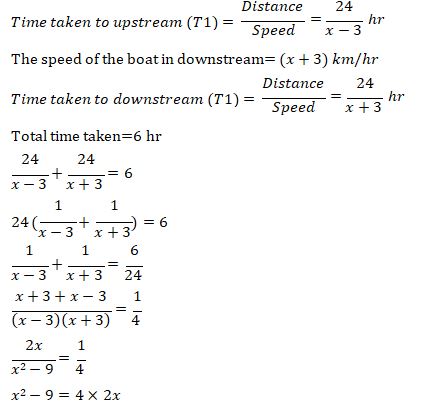
A motor boat heads upstream a distance of 24km on a river whose current is running at 3 km per hour. The trip up and back takes 6 hours. Assuming that the motor boat maintained a constant speed, what was its speed? Sol: Let the speed of the boat in water=𝑥 𝑘𝑚/ℎ𝑟 The speed of the river=3 𝑘𝑚/ℎ𝑟 The distance of river=24 km The speed of the boat in upstream= (𝑥 − 3) 𝑘𝑚/ℎ𝑟