10th Maths Tangent and Secants to a Circle Exercise 9.3 Solutions

TS 10th Class Maths Solutions - Tangents and Secants to a Circle

TS 10th Class Maths Solutions

Chapter 9: Tangents and Secants to a Circle
Exercise 9.3
1

A chord of a circle of radius 10 cm subtends a right angle at the centre. Find the area of the corresponding: (use π = 3.14)

(i) Minor segment

(ii) Major segment. (A.P. Mar. '16, June '15)
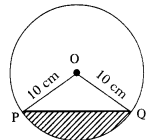
Diagram: Circle with chord subtending right angle at center

Given:

Angle subtended by the chord = 90°

Radius of the circle = 10 cm

Solution:

Area of the minor segment = Area of the sector POQ - Area of ∆POQ

Area of the sector = (x°/360°) × πr²

= (90/360) × 3.14 × 10 × 10 = 78.5 cm²

Area of the triangle POQ = ½ × Base × Height

= ½ × 10 × 10 = 50 cm²

∴ Area of the minor segment = 78.5 - 50 = 28.5 cm²

Area of the major segment = Area of the circle - Area of the minor segment

= 3.14 × 10 × 10 - 28.5

= 314 - 28.5 = 285.5 cm²

(i) Area of minor segment = 28.5 cm²

(ii) Area of major segment = 285.5 cm²

2

A chord of a circle of radius 12 cm subtends an angle of 120° at the centre. Find the area of the corresponding minor segment of the circle (use π = 3.14 and √3 = 1.732).
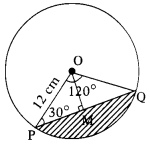
Diagram: Circle with chord subtending 120° angle at center

Given:

Radius of the circle r = 12 cm

Solution:

Area of the sector = (x°/360°) × πr²

Here x = 120°

= (120°/360°) × 3.14 × 12 × 12 = 150.72 cm²

Drop a perpendicular from 'O' to the chord 'PQ'

∆OPM = ∆OQM [∵ OP = OQ, ∠P = ∠Q; angles opposite to equal sides OP & OQ, ∠OMP = ∠OMQ by A.A.S]

∴ ∆OPQ = ∆OPM + ∆OQM = 2(∆OPM)

Area of ∆OPM = ½ × PM × OM

But cos 30° = PM/OP

[∴ In ∆OPQ ∠POQ = 120° ∠OPQ = ∠OQP = (180-120°)/2 = 30°]

∴ PM = 12 × √3/2 = 6√3

Also sin 30° = OM/OP

⇒ ½ = OM/12 ⇒ OM = 12/2 = 6

∴ ∆OPM = ½ × 6√3 × 6 = 18 × 1.732 = 31.176 cm²

∴ ∆OPQ = 2 × 31.176 = 62.352 cm²

Area of the minor segment PQ = (Area of the sector) - (Area of the ∆OPQ)

= 150.72 - 62.352 = 88.368 cm²

Area of the minor segment = 88.368 cm²
3

A car has two wipers which do not overlap. Each wiper has a blade of length 25cm sweeping through an angle of 115°. Find the total area cleaned at each sweep of the blades (use π = 22/7).
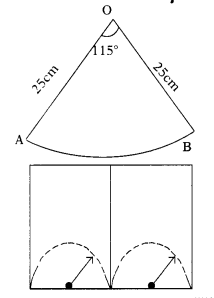
Diagram: Two wipers sweeping 115° each

Given:

Angle made by each blade = 115°

Length of wiper blade (radius) = 25 cm

Solution:

It is evident that each wiper sweeps a sector of a circle of radius 25cm and sector angle 115°.

Area of a sector = (θ°/360°) × πr²

Total area cleaned at each sweep of the blades = 2 × (θ°/360°) × πr²

= 2 × (115°/360°) × (22/7) × 25 × 25

= 2 × (23/72) × (22/7) × 25 × 25

= (23/36) × (22/7) × 25 × 25

= 1254.96 cm²

Total area cleaned = 1254.96 cm²
4

Find the area of the shaded region in the figure, where ABCD is a square of side 10cm and semicircles are drawn with each side of the square as diameter (use π = 3.14).
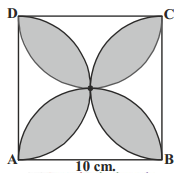
Diagram: Square with semicircles on each side

Given:

Square ABCD with side 10 cm

Solution:

Let us mark the four unshaded regions as I, II, III and IV.

Area of I + Area of III = Area of ABCD - Areas of 2 semicircles with radius 5 cm

= 10 × 10 - 2 × ½ × π × 5²

= 100 - 3.14 × 25

= 100 - 78.5 = 21.5 cm²

Similarly, Area of II + Area of IV = 21.5 cm²

So, area of the shaded region = area of ABCD - Area of unshaded region

= 100 - 2 × 21.5

= 100 - 43 = 57 cm²

Area of the shaded region = 57 cm²
5

Find the area of the shaded region in the figure, if ABCD is a square of side 7cm and APD and BPC are semi-circles (use π = 22/7).
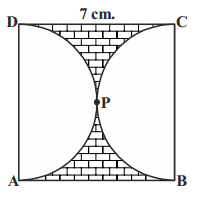
Diagram: Square with two semicircles on opposite sides

Given:

ABCD is a square of side 7 cm

Solution:

Area of the shaded region = Area of ABCD - Area of 2 semi-circles with radius 7/2 = 3.5 cm

APD and BPC are semi-circles

= 7 × 7 - 2 × ½ × (22/7) × 3.5 × 3.5

= 49 - 38.5 = 10.5 cm²

Area of shaded region = 10.5 cm²
6

In figure, OACB is a quadrant of a circle with centre 'O' and radius 3.5 cm. If OD = 2 cm, find the area of the shaded region (use π = 22/7).
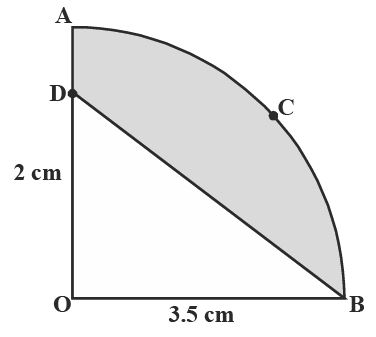
Diagram: Quadrant of a circle with triangle removed

Given:

OACB is a quadrant of a circle with radius 3.5 cm

OD = 2 cm

Solution:

Area of the shaded region = Area of the sector - Area of ABOD

= (x°/360°) × πr² - ½ × OB × OD

= (90°/360°) × (22/7) × 3.5 × 3.5 - ½ × 3.5 × 2

= ¼ × (22/7) × 3.5 × 3.5 - 3.5

= ¼ × (22/7) × 12.25 - 3.5

= 9.625 - 3.5 = 6.125 cm²

Area of shaded region = 6.125 cm²
7

AB and CD are respectively arcs of two concentric circles of radii 21cm and 7cm with centre 'O' (see figure). If ∠AOB = 30°, find the area of the shaded region (Use π = 22/7).
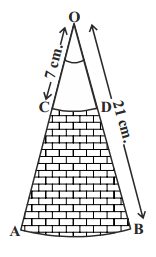
Diagram: Two concentric circles with sector

Given:

Radius of larger circle = 21 cm

Radius of smaller circle = 7 cm

∠AOB = 30°

Solution:

Area of the shaded region = Area of sector OAB - Area of the sector OCD

= (30°/360°) × (22/7) × 21 × 21 - (30°/360°) × (22/7) × 7 × 7

= (30°/360°) × (22/7) × (21 × 21 - 7 × 7)

= 1/12 × (22/7) × (441 - 49)

= 1/6 × (11/7) × 392

= 1/6 × 11 × 56

= (11 × 28)/3 = 102.67 cm²

Area of the shaded region = 102.67 cm²
8

Calculate the area of the designed region in figure, common between the two quadrants of the circles of radius 10 cm each (use π = 3.14).
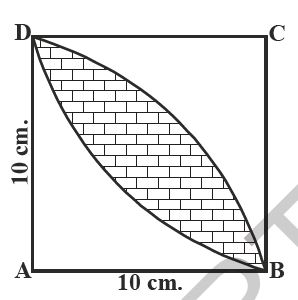
Diagram: Two intersecting quadrants

Given:

Radius of the circle (r) = 10 cm

Solution:

Area of the designed region = 2 [Area of quadrant ABYD - Area of ∆ABD]

= 2 [¼ × πr² - ½ × Base × Height]

= 2 [(¼ × 3.14 × 10 × 10) - (½ × 10 × 10)]

= 2 [78.5 - 50]

= 2 × 28.5 = 57 cm²
Area of the designed region = 57 cm²

10th Maths Tangent and Secants to a Circle Exercise 9.2 Solutions


Exercise 9.2 Solutions – Class X Mathematics


Exercise 9.2 Solutions

Class X Mathematics textbook by the State Council of Educational Research and Training, Telangana, Hyderabad

Problem 1

Choose the correct answer and give justification for each.

(i) The angle between a tangent to a circle and the radius drawn at the point of contact is

(a) 60°
(b) 30°
(c) 45°
(d) 90°

Justification: By theorem, the tangent at any point of a circle is perpendicular to the radius through the point of contact.

(ii) From a point Q, the length of the tangent to a circle is 24 cm and the distance of Q from the centre is 25 cm. The radius of the circle is

(a) 7cm
(b) 12 cm
(c) 15cm
(d) 24.5cm

Justification: Using Pythagoras theorem:
\( r = \sqrt{OQ^2 – PQ^2} = \sqrt{25^2 – 24^2} = \sqrt{625 – 576} = \sqrt{49} = 7 \, \text{cm} \)

(iii) If AP and AQ are the two tangents to a circle with centre O so that \(\angle POQ = 110^\circ\), then \(\angle PAQ\) is equal to

(a) 60°
(b) 70°
(c) 80°
(d) 90°

Justification: In quadrilateral APOQ, \(\angle PAQ = 180^\circ – \angle POQ = 180^\circ – 110^\circ = 70^\circ\) (since \(\angle OAP = \angle OQP = 90^\circ\))

(iv) If tangents PA and PB from a point P to a circle with centre O are inclined to each other at angle of 80°, then \(\angle POA\) is equal to

(a) 50°
(b) 60°
(c) 70°
(d) 80°

Justification: \(\angle APB = 80^\circ\), so \(\angle APO = 40^\circ\). In right triangle OAP, \(\angle POA = 90^\circ – 40^\circ = 50^\circ\)

(v) In the figure XY and X’Y’ are two parallel tangents to a circle with centre O and another tangent AB with point of contact C intersecting XY at A and X’Y’ at B then \(\angle AOB\) =

(a) 80°
(b) 100°
(c) 90°
(d) 60°

Justification: OA bisects \(\angle COY\) and OB bisects \(\angle COY’\). Since XY ∥ X’Y’, \(\angle COY + \angle COY’ = 180^\circ\), so \(\angle AOB = 90^\circ\)

Problem 2

Two concentric circles of radii 5 cm and 3 cm are drawn. Find the length of the chord of the larger circle which touches the smaller circle.

Solution:

[Diagram description: Two concentric circles with radii 5cm and 3cm. Chord AB of larger circle touches smaller circle at P]

Let O be the common center. AB is chord of larger circle touching smaller circle at P.

OP ⊥ AB (radius perpendicular to tangent at point of contact)

In right triangle OPA:

\( OA^2 = OP^2 + AP^2 \)

\( 5^2 = 3^2 + AP^2 \) ⇒ \( AP^2 = 25 – 9 = 16 \) ⇒ \( AP = 4 \, \text{cm} \)

AB = 2 × AP = 8 cm (since OP bisects the chord AB)

Problem 3

Prove that the parallelogram circumscribing a circle is a rhombus.

Solution:

Let ABCD be a parallelogram circumscribing a circle.

For a quadrilateral to circumscribe a circle, the sums of lengths of opposite sides must be equal.

Thus, AB + CD = AD + BC

But in parallelogram, AB = CD and AD = BC (opposite sides equal)

Therefore, 2AB = 2AD ⇒ AB = AD

Since all adjacent sides are equal, ABCD is a rhombus.

Problem 4

A triangle ABC is drawn to circumscribe a circle of radius 3 cm such that the segments BD and DC into which BC is divided by the point of contact D are of length 9 cm and 3 cm, respectively. Find the sides AB and AC.

Solution:

[Diagram description: Triangle ABC with incircle touching BC at D (BD=9cm, DC=3cm), AB at E, and AC at F]

Let the circle touch AB at E and AC at F.

From same external point, tangent lengths are equal:

AE = AF = x, BE = BD = 9 cm, CF = CD = 3 cm

Perimeter p = AB + BC + CA = (x+9) + 12 + (x+3) = 2x + 24

Semi-perimeter s = x + 12

Area = r × s = 3(x + 12)

Also by Heron’s formula: \( \sqrt{(x+12)(x)(3)(9)} = 3(x+12) \)

Squaring both sides: \( 27x(x+12) = 9(x+12)^2 \) ⇒ \( 3x = x+12 \) ⇒ \( x = 6 \, \text{cm} \)

Thus, AB = x + 9 = 15 cm, AC = x + 3 = 9 cm

Problem 5

Draw a circle of radius 6cm. From a point 10 cm away from its centre, construct the pair of tangents to the circle and measure their lengths. Verify by using Pythagoras Theorem.

Solution:

Construction Steps:

  1. Draw circle with center O, radius 6cm
  2. Mark point P 10cm from O
  3. Draw perpendicular bisector of OP to find midpoint M
  4. With M as center and MO as radius, draw circle intersecting first circle at Q and R
  5. Join PQ and PR – these are the required tangents

Verification:

Length of tangent = \( \sqrt{OP^2 – r^2} = \sqrt{10^2 – 6^2} = \sqrt{64} = 8 \, \text{cm} \)

Measured lengths should match this calculation.

Problem 6

Construct a tangent to a circle of radius 4cm from a point on the concentric circle of radius 6cm and measure its length. Also verify the measurement by actual calculation.

Solution:

Construction Steps:

  1. Draw circle C1 with center O, radius 4cm
  2. Draw concentric circle C2 with radius 6cm
  3. Mark point P on C2
  4. Join OP and find its midpoint M
  5. With M as center and MO as radius, draw circle intersecting C1 at Q
  6. Join PQ – this is the required tangent

Verification:

Length of tangent = \( \sqrt{OP^2 – r^2} = \sqrt{6^2 – 4^2} = \sqrt{20} = 2\sqrt{5} \, \text{cm} \approx 4.47 \, \text{cm} \)

Problem 7

Draw a circle with the help of a bangle. Take a point outside the circle. Construct the pair of tangents from this point to the circle and measure them. Write your conclusion.

Solution:

Construction Steps:

  1. Trace the bangle to draw a circle (unknown center)
  2. Draw two chords and their perpendicular bisectors to find center O
  3. Mark external point P
  4. Join OP and find its midpoint M
  5. With M as center and MO as radius, draw circle intersecting original circle at Q and R
  6. Join PQ and PR – these are the required tangents

Conclusion: Both tangents from an external point to a circle are equal in length.

Problem 8

In a right triangle ABC, a circle with a side AB as diameter is drawn to intersect the hypotenuse AC in P. Prove that the tangent to the circle at P bisects the side BC.

Solution:

[Diagram description: Right triangle ABC with right angle at B. Semicircle on AB intersects AC at P. Tangent at P meets BC at Q]

Given: ∠ABC = 90°, AB is diameter ⇒ ∠APB = 90° (angle in semicircle)

Let tangent at P meet BC at Q

∠BPQ = ∠BAP (angles in alternate segment)

But ∠BAP = ∠BCA (both complementary to ∠ABC)

Thus, ∠BPQ = ∠BCA ⇒ PQ ∥ AC (corresponding angles equal)

In ΔABC, P is midpoint of AC (since PQ ∥ AC and passes through center)

Thus, Q must be midpoint of BC (by midpoint theorem)

Problem 9

Draw a tangent to a given circle with center O from a point ‘R’ outside the circle. How many tangents can be drawn to the circle from that point?

Solution:

Number of tangents: Exactly two tangents can be drawn from an external point to a circle.

Construction Steps:

  1. Join OR and find its midpoint M
  2. With M as center and MO as radius, draw circle intersecting given circle at P and Q
  3. Join RP and RQ – these are the two required tangents

Verification: Both RP and RQ will be equal in length and perpendicular to OP and OQ respectively.


10th Maths Tangent and Secants to a Circle Exercise 9.1 Solutions

Exercise 9.1 Solutions – Class X Mathematics

Exercise 9.1 Solutions

Class X Mathematics textbook by the State Council of Educational Research and Training, Telangana, Hyderabad

Problem 1

Fill in the blanks:

(i) A tangent to a circle touches it in one point(s).

Explanation: By definition, a tangent touches a circle at exactly one point.

(ii) A line intersecting a circle in two points is called a secant.

(iii) Number of tangents can be drawn to a circle parallel to the given tangent is one.

Explanation: For any given tangent, there exists exactly one other tangent parallel to it.

(iv) The common point of a tangent to a circle and the circle is called point of contact.

(v) We can draw infinite tangents to a given circle.

Explanation: There are infinitely many points on a circle, and at each point there’s a unique tangent.

(vi) A circle can have two parallel tangents at the most.

Explanation: A circle can have exactly two parallel tangents – one on each side.

Problem 2

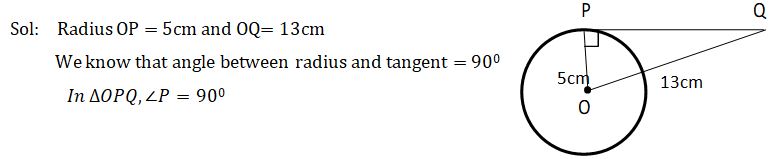
A tangent PQ at a point P of a circle of radius 5 cm meets a line through the centre O at a point Q so that \( \text{OQ} = 13 \, \text{cm} \). Find length of PQ.

[Diagram description: Circle with center O, radius 5cm. Point P on circumference with tangent PQ meeting extended line OQ at Q, where OQ = 13cm]

Solution:

Given: OP = radius = 5 cm, OQ = 13 cm

Since PQ is tangent, OP ⊥ PQ (radius perpendicular to tangent at point of contact)

In right triangle OPQ:

\( OP^2 + PQ^2 = OQ^2 \)

\( 5^2 + PQ^2 = 13^2 \)

\( 25 + PQ^2 = 169 \)

\( PQ^2 = 144 \)

\( PQ = 12 \, \text{cm} \)

Problem 3

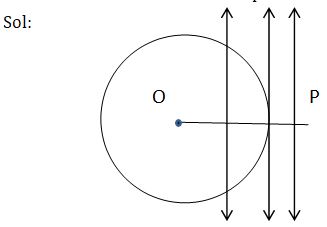
Draw a circle and two lines parallel to a given line drawn outside the circle such that one is a tangent and the other, a secant to the circle.

Solution:

Construction Steps:

  1. Draw a circle with center O and any radius
  2. Draw a line l outside the circle (not intersecting the circle)
  3. Draw perpendicular from O to line l, meeting at point P
  4. With OP as distance, draw line m parallel to l – this will be tangent (touches at one point)
  5. Draw another line n parallel to l at distance less than OP – this will be secant (intersects at two points)
[Diagram description: Circle with two parallel lines outside it, one tangent (touching at one point) and one secant (intersecting at two points)]

Problem 4

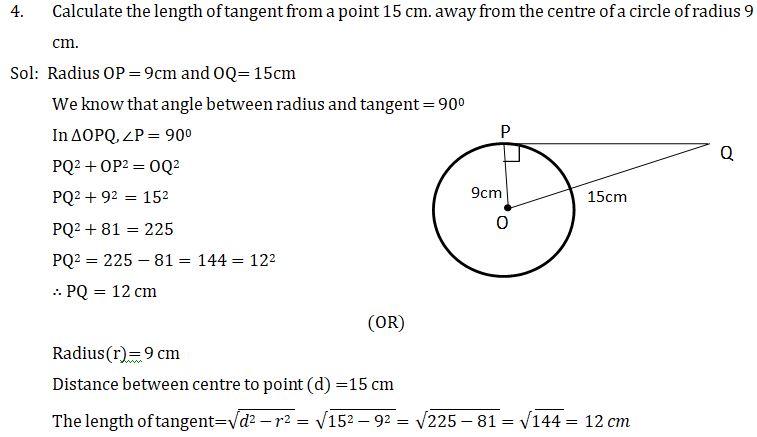
Calculate the length of tangent from a point 15 cm away from the centre of a circle of radius 9 cm.

Solution:

Given: Distance from center (d) = 15 cm, Radius (r) = 9 cm

Length of tangent (l) from external point is given by:

\( l = \sqrt{d^2 – r^2} = \sqrt{15^2 – 9^2} = \sqrt{225 – 81} = \sqrt{144} = 12 \, \text{cm} \)

Problem 5

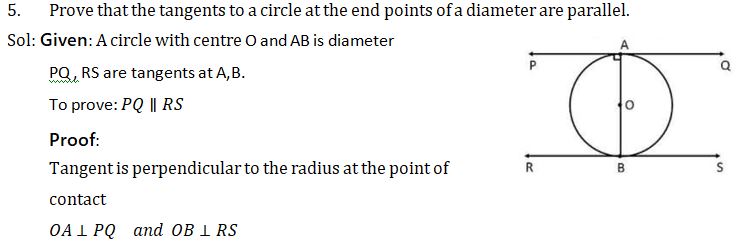
Prove that the tangents to a circle at the end points of a diameter are parallel.

[Diagram description: Circle with diameter AB, tangents at A and B both perpendicular to AB]

Solution:

Let AB be diameter of circle with center O.

Let PA be tangent at A and QB be tangent at B.

Property: Tangent is perpendicular to radius at point of contact.

Thus, PA ⊥ OA and QB ⊥ OB

But OA and OB lie on same line AB (diameter)

Therefore, PA ⊥ AB and QB ⊥ AB

If two lines are both perpendicular to the same line, they are parallel to each other.

Hence, PA ∥ QB

 Tangents and Secants to a Circle

Tangents and Secants to a Circle

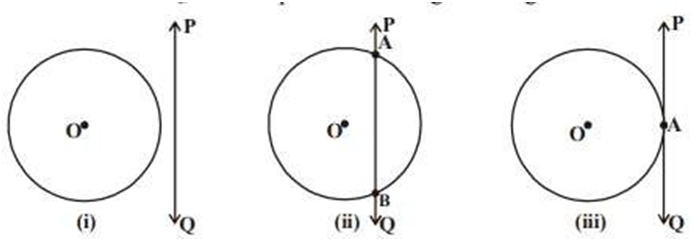
  • The line PQ and the circle have no common point. In this case PQ is a nonintersecting line with respect to the circle.
  • The line PQ intersects the circle at two points A and B. It forms a chord AB on the circle with two common points. In this case the line PQ is a secant of the circle.
  • There is only one point A, common to the line PQ and the circle. This line is called a tangent to the circle.

The common point of the tangent and the circle is called the point of contact and the tangent is said to touch the circle at the common point.

  • We can draw infinite tangents to the circle.
  • We can draw two tangents to the circle from a point away from it.
  • The tangent at any point of a circle is perpendicular to the radius through the point of contact.

EXERCISE-9.I

  1. Fill in the blanks
    • i) A tangent to a circle intersects it in ….one………… point (s).
    • ii) A line intersecting a circle in two points is called a………secant……
    • iii) The number of tangents drawn at the end points of the diameter is……. two…….
    • iv) The common point of a tangent to a circle and the circle is called ……. point of contact…..
    • v) We can draw…. infinite….. tangents to a given circle.
  2. A tangent PQ at a point P of a circle of radius 5 cm meets a line through the centre O at a point Q so that OQ = 13 cm. Find length of PQ.

𝑃𝑄2 + 𝑂𝑃2 = 𝑂𝑄2

𝑃𝑄2 + 52 = 132

𝑃𝑄2 + 25 = 169

𝑃𝑄2 = 169 − 25 = 144 = 122

∴ 𝑃𝑄 = 12 𝑐𝑚

3. Draw a circle and two lines parallel to a given line such that one is a tangent and the other, a secant to the circle.

∠𝑂𝐴𝑃 = 900 𝑎𝑛d ∠𝑂𝐵𝑆 = 900

⇒ ∠𝐵𝐴𝑃 = 900 𝑎𝑛𝑑 ∠𝐴𝐵𝑆 = 900

⇒ ∠𝐵𝐴𝑃 = ∠𝐴𝐵𝑆

⇒ 𝐴𝑙𝑡𝑒𝑟𝑛𝑎𝑡𝑒 𝑖𝑛𝑡𝑒𝑟𝑖𝑜𝑟 𝑎𝑛𝑔𝑙𝑒𝑠 𝑎𝑟𝑒 𝑒𝑞𝑢𝑎𝑙

⇒ 𝑃𝑄 ∥ 𝑅𝑆

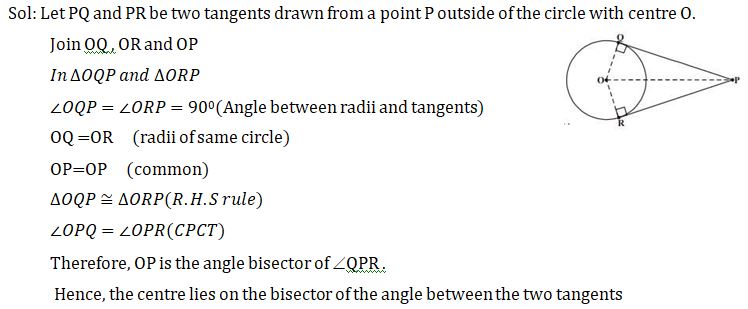
Prob1:Prove The centre of a circle lies on the bisector of the angle between two tangents drawn from a point outside it.