These solutions are based on the Telangana State Class X Mathematics textbook, focusing on the nature of roots of quadratic equations and applications to word problems. Mathematical expressions are rendered using MathJax.
1. Find the nature of the roots of the following quadratic equations. If real roots exist, find them.
(i) \( 2x^2 – 3x + 5 = 0 \)
For \( ax^2 + bx + c = 0 \), nature of roots depends on the discriminant: \( \Delta = b^2 – 4ac \).
Since \( \Delta > 0 \), real roots exist, so it is possible.
Roots: \( x = \pm \sqrt{400} = \pm 20 \). Take \( x = 20 \).
Breadth: \( 20 \) m, length: \( 40 \) m.
Check: Area = \( 40 \cdot 20 = 800 \) m².
Possible: Yes, Length: 40 m, Breadth: 20 m
4. The sum of the ages of two friends is 20 years. Four years ago, the product of their ages in years was 48. Is the above situation possible? If so, determine their present ages.
Roots: \( x = \pm \sqrt{16} = \pm 4 \). Take \( x = 4 \), \( y = 16 \).
Ages 4 years ago: \( 0 \) and \( 12 \), product = \( 0 \cdot 12 = 0 \), not 48. The discriminant suggests real roots, but ages must be positive and yield a product of 48 four years ago, which isn’t satisfied here.
Possible: No
5. Is it possible to design a rectangular park of perimeter 80 m and area 400 m²? If so, find its length and breadth. Comment on your answer.
Let length be \( x \) m, breadth be \( y \) m.
Perimeter: \( 2(x + y) = 80 \implies x + y = 40 \implies y = 40 – x \).
These solutions are based on the Telangana State Class X Mathematics textbook, focusing on solving quadratic equations using the quadratic formula and applying them to word problems. Mathematical expressions are rendered using MathJax.
1. Find the roots of the following quadratic equations, if they exist.
(i) \( 2x^2 + x – 4 = 0 \)
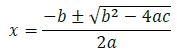
Quadratic formula: \( x = \frac{-b \pm \sqrt{b^2 – 4ac}}{2a} \), where \( a = 2 \), \( b = 1 \), \( c = -4 \).
5. In a class test, the sum of Moulika’s marks in Mathematics and English is 30. If she got 2 marks more in Mathematics and 3 marks less in English, the product of her marks would have been 210. Find her marks in the two subjects.
Let marks in Mathematics be \( x \), English be \( y \).
\( x + y = 30 \implies y = 30 – x \).
New marks: Mathematics = \( x + 2 \), English = \( y – 3 \).
Marks: Mathematics = 13, English = 17 (or vice versa)
6. The diagonal of a rectangular field is 60 meters more than the shorter side. If the longer side is 30 meters more than the shorter side, find the sides of the field.
Let the shorter side be \( x \) m, longer side = \( x + 30 \), diagonal = \( x + 60 \).
8. A train travels 360 km at a uniform speed. If the speed had been 5 km/h more, it would have taken 1 hour less for the same journey. Find the speed of the train.
Let the speed be \( x \) km/h.
Time at speed \( x \): \( \frac{360}{x} \), at \( x + 5 \): \( \frac{360}{x + 5} \).
9. Two water taps together can fill a tank in \( 9 \frac{3}{8} \) hours. The tap of larger diameter takes 10 hours less than the smaller one to fill the tank separately. Find the time in which each tap can separately fill the tank.
\( 9 \frac{3}{8} = \frac{75}{8} \) hours.
Let the smaller tap take \( x \) hours, larger tap = \( x – 10 \).
10. An express train takes 1 hour less than a passenger train to travel 132 km between Mysore and Bengaluru (without taking into consideration the time they stop at intermediate stations). If the average speed of the express train is 11 km/h more than that of the passenger train, find the average speed of the two trains.
Let the speed of the passenger train be \( x \) km/h, express train = \( x + 11 \).
12. An object is thrown upwards with an initial velocity of 17 m/sec from a building with 12 m height. It is at a height of \( S = 12 + 17t – 5t^2 \) from the ground after a flight of \( t \) seconds. Find the time taken by the object to touch the ground.
Ground: \( S = 0 \), so \( 12 + 17t – 5t^2 = 0 \).
13. If a polygon of \( n \) sides has \( \frac{1}{2} n(n-3) \) diagonals. How many sides are there in a polygon with 65 diagonals? Is there a polygon with 50 diagonals?
These solutions are based on the Telangana State Class X Mathematics textbook, focusing on solving quadratic equations by factorisation and applying them to word problems. Mathematical expressions are rendered using MathJax.
1. Find the roots of the following quadratic equations by factorisation:
(i) \( x^2 – 3x – 10 = 0 \)
We need two numbers whose product is \( -10 \cdot 1 = -10 \) and sum is \( -3 \).
Solve: \( x = 12 \), \( x = -5 \). Since length is positive, \( x = 12 \).
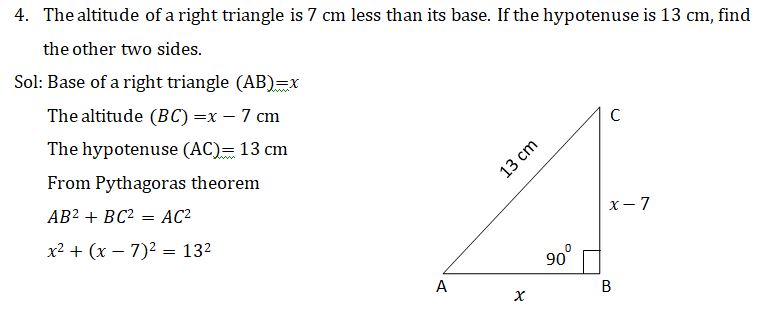
Base: \( 12 \) cm, altitude: \( 12 – 7 = 5 \) cm.
Check: \( 12^2 + 5^2 = 144 + 25 = 169 = 13^2 \).
Sides: Base = 12 cm, Altitude = 5 cm
5. A cottage industry produces a certain number of pottery articles in a day. It was observed on a particular day that the cost of production of each article (in rupees) was 3 more than twice the number of articles produced on that day. If the total cost of production on that day was Rs 90, find the number of articles produced and the cost of each article.
Let the number of articles be \( x \).
Cost of each article: \( 2x + 3 \).
Total cost: \( x (2x + 3) = 90 \implies 2x^2 + 3x – 90 = 0 \).
8. Two trains leave a railway station at the same time. The first train travels towards west and the second train towards north. The first train travels 5 km/hr faster than the second train. If after two hours they are 50 km apart, find the average speed of each train.
Let the speed of the second train (north) be \( x \) km/h, first train (west) = \( x + 5 \) km/h.
After 2 hours: Distance west = \( 2(x + 5) \), distance north = \( 2x \).
Speeds: First train (west): 20 km/h, Second train (north): 15 km/h
9. In a class of 60 students, each boy contributed rupees equal to the number of girls and each girl contributed rupees equal to the number of boys. If the total money then collected was Rs 1600, how many boys were there in the class?
Let the number of boys be \( x \), girls = \( 60 – x \).
Boys contribute: \( x \cdot (60 – x) \), girls contribute: \( (60 – x) \cdot x \).
Number of boys: 40 or 20 (both possible, but typically \( 40 \) is chosen as “boys”)
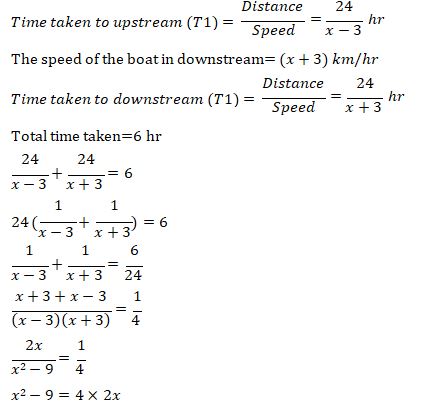
10. A motor boat heads upstream a distance of 24 km in a river whose current is running at 3 km per hour. The trip up and back takes 6 hours. Assuming that the motor boat maintained a constant speed, what was its speed in still water?
Let the boat’s speed in still water be \( x \) km/h.
Upstream speed: \( x – 3 \), downstream speed: \( x + 3 \).
Time upstream: \( \frac{24}{x-3} \), time downstream: \( \frac{24}{x+3} \).
Total time: \( \frac{24}{x-3} + \frac{24}{x+3} = 6 \).
These solutions are based on the Telangana State Class X Mathematics textbook, focusing on quadratic equations. Mathematical expressions are rendered using MathJax.
1. Check whether the following are quadratic equations:
This is a quadratic equation (\( a = 2 \), \( b = -13 \), \( c = 9 \)).
Conclusion: Yes, it is a quadratic equation.
2. Represent the following situations in the form of quadratic equations:
(i) The area of a rectangular plot is 528 m². The length of the plot is one meter more than twice its breadth. We need to find the length and breadth of the plot.
Let the breadth of the plot be \( x \) meters.
Length is one meter more than twice the breadth: \( 2x + 1 \).
Area of the rectangle: \( \text{length} \times \text{breadth} = 528 \).
So, \( x (2x + 1) = 528 \).
Expand: \( 2x^2 + x = 528 \implies 2x^2 + x – 528 = 0 \).
Quadratic equation: \( 2x^2 + x – 528 = 0 \)
(ii) The product of two consecutive positive integers is 306. We need to find the integers.
Let the first integer be \( x \).
The next consecutive integer is \( x + 1 \).
Their product is 306: \( x (x + 1) = 306 \).
Expand: \( x^2 + x = 306 \implies x^2 + x – 306 = 0 \).
Quadratic equation: \( x^2 + x – 306 = 0 \)
(iii) Rohan’s mother is 26 years older than him. The product of their ages after 3 years will be 360 years. We need to find Rohan’s present age.
Let Rohan’s present age be \( x \) years.
His mother’s present age is \( x + 26 \).
After 3 years: Rohan’s age = \( x + 3 \), mother’s age = \( x + 29 \).
Product of their ages: \( (x + 3)(x + 29) = 360 \).
(iv) A train travels a distance of 480 km at a uniform speed. If the speed had been 8 km/h less, then it would have taken 3 hours more to cover the same distance. We need to find the speed of the train.
Let the speed of the train be \( x \) km/h.
Time to travel 480 km at speed \( x \): \( \frac{480}{x} \) hours.
If speed is \( x – 8 \), time taken: \( \frac{480}{x-8} \).
Standard form of quadratic equation in variable 𝑥 is 𝒂𝒙𝟐 + 𝒃𝒙 + 𝒄 = 𝟎, where 𝑎, 𝑏, 𝑐 are real numbers and 𝑎 ≠ 0.
y = 𝑎𝑥2+ 𝑏𝑥 + 𝑐 is called a quadratic function.
Uses of Quadratic functions. (i) When the rocket is fired upward, then the path of the rocket is defined by a ‘quadratic function.’ (ii) Shapes of the satellite dish, reflecting mirror in a telescope, lens of the eye glasses and orbits of the celestial objects are defined by the quadratic equations. (iii) The path of a projectile is defined by quadratic function. (iv) When the breaks are applied to a vehicle, the stopping distance is calculated by using quadratic equation
Roots of quadratic equation: A real number 𝛼 is called a root of the quadratic equation 𝑎𝑥2 + 𝑏𝑥 + 𝑐 = 0, if 𝑎𝛼2 + 𝑏𝛼 + 𝑐 = 0
Quadratic formula: The roots of a quadratic equation 𝑎𝑥2 + 𝑏𝑥 + 𝑐 = 0 are given by
Nature of roots: The nature of roots of a quadratic equation 𝑎𝑥2 + 𝑏𝑥 + 𝑐 = 0 depends on 𝑏2 − 4𝑎𝑐 is called the discriminant (i) 𝐼𝑓 𝒃𝟐 − 𝟒𝒂𝒄 > 𝟎 𝑡ℎ𝑒𝑛 𝑡ℎ𝑒 𝑟𝑜𝑜𝑡𝑠 𝑎𝑟𝑒 𝑟𝑒𝑎𝑙 𝑎𝑛𝑑 𝑑𝑖𝑠𝑡𝑖𝑛𝑐𝑡 (ii) 𝐼𝑓 𝒃𝟐 − 𝟒𝒂𝒄 = 𝟎 𝑡ℎ𝑒𝑛 𝑡ℎ𝑒 𝑟𝑜𝑜𝑡𝑠 𝑎𝑟𝑒 𝑟𝑒𝑎𝑙 𝑎𝑛𝑑 𝑒𝑞𝑢𝑎𝑙 (iii) 𝐼𝑓 𝒃𝟐 − 𝟒𝒂𝒄 < 𝟎 𝑡ℎ𝑒𝑛 𝑡ℎ𝑒 𝑟𝑜𝑜𝑡𝑠 𝑎𝑟𝑒 𝑛𝑜𝑡 𝑟𝑒𝑎𝑙
Try This
Check whether the following equations are quadratic or not ? (i) 𝑥 2– 6𝑥 – 4 = 0 Sol: Quadratic equation
(ii) 𝑥 3– 6𝑥 2 + 2𝑥 -1 = 0 Sol: Not a quadratic equation(Cubic equation)
(vi) 3y2 = 192 Sol: 3y2 – 192=0 This is a quadratic equation
Example-1.
i. Raju and Rajendar together have 45 marbles. Both of them lost 5 marbles each, and the product of the number of marbles now they have is 124. We would like to find out how many marbles they had previously. Represent the situation mathematically. Sol: Total marbles=45 Let the number of marbles at Raju = 𝑥 Then the number of marbles at Rajendar = 45 − 𝑥 If both of them lost 5 marbles each then The number of marbles at Raju = 𝑥 − 5 The number of marbles at Rajendar = 45 − 𝑥 − 5 = 40 − 𝑥 The product of remaining marbles=124 ⇒ (𝑥 − 5)(40 − 𝑥) = 124 ⇒ 40𝑥 − 𝑥2 − 200 + 5𝑥 = 124 ⇒ −𝑥2 + 45𝑥 − 200 − 124 = 0 ⇒ −𝑥2 + 45𝑥 − 324 = 0 ⇒ 𝑥2 − 45𝑥 + 324 = 0 (multiply with −1)
ii. The hypotenuse of a right triangle is 25 cm. We know that the difference in lengths of the other two sides is 5 cm. We would like to find out the length of the two sides?
Sol: Let the length of smaller side = 𝑥 𝑐𝑚 The length of larger side = (𝑥 + 5)𝑐𝑚 Length of hypotenuse = 25 𝑐𝑚 In a right angle triangle we know that (𝑠𝑖𝑑𝑒)2 + (𝑠𝑖𝑑𝑒)2 = (ℎ𝑦𝑝𝑜𝑡𝑒𝑛𝑢𝑠𝑒)2 (𝑥)2 + (𝑥 + 5)2 = (25)2 𝑥2 + 𝑥2 + 2 × 𝑥 × 5 + 52 = 625 2𝑥2 + 10𝑥 + 25 − 625 = 0 2𝑥2 + 10𝑥 + −600 = 0 𝑥2 + 5𝑥 − 300 = 0 Required quadratic equation: 𝑥2 + 5𝑥 − 300
Example-2. Check whether the following are quadratic equations: i. (𝑥 − 2)2 + 1 = 2𝑥 − 3 Sol: (𝑥 − 2)2 + 1 = 2𝑥 − 3 ⇒ 𝑥2 − 4𝑥 + 4 + 1 − 2𝑥 + 3 = 0 ⇒ 𝑥2 − 6𝑥 + 8 = 0 The given equation is a quadratic equation.
ii. 𝑥(𝑥 + 1) + 8 = (𝑥 + 2)(𝑥 − 2) Sol: 𝑥(𝑥 + 1) + 8 = (𝑥 + 2)(𝑥 − 2) ⇒ 𝑥2 + 𝑥 + 8 = 𝑥2 − 22 ⇒ 𝑥2 + 𝑥 + 8 − 𝑥2 + 4 = 0 ⇒ 𝑥 + 12 = 0 The given equation is not a quadratic equation.
iii. 𝑥(2𝑥 + 3) = 𝑥2 + 1 Sol: 𝑥(2𝑥 + 3) = 𝑥2 + 1 ⇒ 2𝑥2 + 3𝑥 − 𝑥2 − 1 = 0 ⇒ 𝑥2 + 3𝑥 − 1 = 0 The given equation is a quadratic equation
i. The area of a rectangular plot is 528 m2 . The length of the plot (in metres) is one more than twice its breadth. We need to find the length and breadth of the plot. Sol: Let breadth of rectangular plot (𝑏) = 𝑥 𝑚 Length of rectangular plot (𝑙) = (2𝑥 + 1)𝑚 Given area of the rectangular plot = 528 𝑚2 𝑙 × 𝑏 = 528 (2𝑥 + 1) × 𝑥 = 528 2𝑥2 + 𝑥 − 528 = 0 This is the required quadratic equation. ii. The product of two consecutive positive integers is 306. We need to find the integers. Sol: Let the two consecutive positive integers be 𝑥 , 𝑥 + 1 Given the product of two consecutive positive integers = 306 𝑥 × (𝑥 + 1) = 306 ⟹ 𝑥2 + 𝑥 − 306 = 0 This is the required quadratic equation iii. Rohan’s mother is 26 years older than him. The product of their ages after 3 years will be 360 years. We need to find Rohan’s present age. Sol: Let Rohan’s age=𝑥 years Rohan’s mother age=(𝑥 + 26)𝑦𝑒𝑎𝑟𝑠 After 3 years Rohan’s age=𝑥 + 3 years Rohan’s mother age=(𝑥 + 26 + 3) = (𝑥 + 29)𝑦𝑒𝑎𝑟𝑠 Given the product of their ages after 3 years=360 years ⇒ (𝑥 + 3)(𝑥 + 29) = 360 ⇒ 𝑥2 + 29𝑥 + 3𝑥 + 87 − 360 = 0 ⇒ 𝑥2 + 32𝑥 − 273 = 0 This is the required quadratic equation.
iv. A train travels a distance of 480 km at a uniform speed. If the speed had been 8 km/h less, then it would have taken 3 hours more to cover the same distance. We need to find the speed of the train. Sol: Let the speed of the train= 𝑥 𝑘𝑚/ℎ Distance= 480 km 𝑇𝑖𝑚𝑒(𝑇1) =𝐷𝑖𝑠𝑡𝑎𝑛𝑐𝑒/𝑆𝑝𝑒𝑒𝑑=480-𝑥/ℎ If the speed had been 8 km/h less then speed=(𝑥 − 8) 𝑘𝑚/ℎ 𝑇𝑖𝑚𝑒(𝑇2) =𝐷𝑖𝑠𝑡𝑎𝑛𝑐𝑒/𝑆𝑝𝑒𝑒𝑑=480/𝑥 − 8*ℎ Difference of times(𝑇2 − 𝑇1) =3h
SOLUTIONS OF A QUADRATIC EQUATIONS BY FACTORISATION
A real number is called a root of the quadratic equation 𝑎𝑥2 + 𝑏𝑥 + 𝑐 = 0, if 𝑎𝛼2 + 𝑏 𝑎 + 𝑐 = 0 We also say that x = 𝛼 is a solution of the quadratic equation.
5.A cottage industry produces a certain number of pottery articles in a day. It was observed on a particular day that the cost of production of each article (in rupees) was 3 more than twice the number of articles produced on that day. If the total cost of production on that day was Rs 90, find the number of articles produced and the cost of each article. Sol: Let the number of articles produced=𝑥 The cost of each article=𝑅𝑠 (2𝑥 + 3) Given the total cost of production on that day=Rs 90 𝑥(2𝑥 + 3) = 90 2𝑥2 + 3𝑥 − 90 = 0 2𝑥2 − 12𝑥 + 15𝑥 − 90 = 0 2𝑥(𝑥 − 6) + 15(𝑥 − 6) = 0 (𝑥 − 6)(2𝑥 + 15) = 0 𝑥 − 6 = 0 𝑜𝑟 2𝑥 + 15 = 0 𝑥 = 6 𝑜𝑟 𝑥 =−15/2 ∴ 𝑥 = 6 ( 𝑁𝑢𝑚𝑏𝑒𝑟 𝑜𝑓 𝑎𝑟𝑡𝑖𝑐𝑙𝑒𝑠 𝑖𝑠 𝑎𝑙𝑤𝑎𝑦𝑠 𝑐𝑎𝑛′𝑡𝑏𝑒 𝑛𝑒𝑔𝑎𝑡𝑖𝑣𝑒) The number of articles produced= 𝑥 =6 The cost of each article=𝑅𝑠 (2𝑥 + 3)=𝑅𝑠 (2 × 6 + 3) = 𝑅𝑠 15.
Find the dimensions of a rectangle whose perimeter is 28 meters and whose area is 40 square meters. Sol: Let the length of the rectangle=𝑙 , breadth =𝑏 Perimeter of the rectangle=28 m 2(𝑙 + 𝑏) = 28 ⇒ 𝑙 + 𝑏 =28/2 ⇒ 𝑙 + 𝑏 = 14 ⇒ 𝑏 = 14 − 𝑙 Area of the square=40 square meters. ⇒ 𝑙 × 𝑏 = 40 ⇒ 𝑙(14 − 𝑙) = 40 ⇒ 14𝑙 − 𝑙2 − 40 = 0 ⇒ −𝑙2 + 14𝑙 − 40 = 0 ⇒ 𝑙2 − 14𝑙 + 40 = 0 ⇒ 𝑙2 − 10𝑙 − 4𝑙 + 40 = 0 ⇒ 𝑙(𝑙 − 10) − 4(𝑙 − 10) = 0 ⇒ (𝑙 − 10)(𝑙 − 4) = 0 ⇒ 𝑙 − 10 = 0 𝑜𝑟 𝑙 − 4 = 0 ⇒ 𝑙 = 10 𝑜𝑟 𝑙 = 4 𝐼𝑓 𝑙 = 10 𝑚 𝑡ℎ𝑒𝑛 𝑏 = 14 − 10 = 4 𝑚 𝐼𝑓 𝑙 = 4 𝑚 𝑡ℎ𝑒𝑛 𝑏 = 14 − 4 = 10 𝑚 The dimensions of the rectangle are 10 m and 4 m.
The base of a triangle is 4cm longer than its altitude. If the area of the triangle is 48 sq.cm then find its base and altitude. Sol: Let altitude (h)=𝑥 The base of a triangle(b)=(𝑥 + 4) The area of the triangle = 48 sq.cm 1/2× 𝑏 × ℎ = 48 (𝑥 + 4) × 𝑥 = 48 × 2 𝑥2 + 4𝑥 − 96 = 0 𝑥2 − 8𝑥 + 12𝑥 − 96 = 0 𝑥(𝑥 − 8) + 12(𝑥 − 8) = 0 (𝑥 − 8)(𝑥 + 12) = 0 𝑥 − 8 = 0 𝑜𝑟 𝑥 + 12 = 0 𝑥 = 8 𝑜𝑟 𝑥 = −12 ∴ 𝑥 = 8 ( 𝐴𝑙𝑡𝑖𝑡𝑢𝑑𝑒 𝑐𝑎𝑛′𝑡𝑏𝑒 𝑛𝑒𝑔𝑎𝑡𝑖𝑣𝑒) Altitude of the triangle=𝑥 = 8 𝑐𝑚 Base of the triangle=𝑥 + 4 = 8 + 4 = 12 𝑐𝑚.
8.Two trains leave a railway station at the same time. The first train travels towards west and the second train towards north. The first train travels 5 km/hr faster than the second train. If after two hours they are 50 km. apart find the average speed of each train. Sol: Let the speed of second train=𝑥 𝑘𝑚/ℎ𝑟 The speed of first train=(𝑥 + 5)𝑘𝑚/ℎ𝑟 Time (t)=2 hr Distance travelled by second train=𝑠 × 𝑡 = 2 × 𝑥 = 2𝑥 𝑘𝑚 Distance travelled by first train=𝑠 × 𝑡 = 2 × (𝑥 + 5) = (2𝑥 + 10)𝑘𝑚
In a class of 60 students, each boy contributed rupees equal to the number of girls and each girl contributed rupees equal to the number of boys. If the total money then collected was ₹1600. How many boys are there in the class? Sol: Total number of students=60 Let the number of boys=𝑥 The number of girls=60 − 𝑥 Money contributed by the boys=𝑥 × (60 − 𝑥) = 60𝑥 − 𝑥2 Money contributed by the boys=(60 − 𝑥) × 𝑥 = 60𝑥 − 𝑥2 Total money collected=₹1600 60𝑥 − 𝑥2 + 60𝑥 − 𝑥2 = 1600 −2𝑥2 + 120𝑥 − 1600 = 0 𝑥2 − 60𝑥 + 800 = 0(𝑑𝑖𝑣𝑖𝑑𝑖𝑛𝑔 𝑏𝑦 ′ − 2′) 𝑥2 − 40𝑥 − 20𝑥 + 800 = 0 𝑥(𝑥 − 40) − 20(𝑥 − 40) = 0 (𝑥 − 40)(𝑥 − 20) = 0 𝑥 − 40 = 0 𝑜𝑟 𝑥 − 20 = 0 𝑥 = 40 𝑜𝑟 𝑥 = 20 ∴ The number of boys in the class=40 or 20.
A motor boat heads upstream a distance of 24km on a river whose current is running at 3 km per hour. The trip up and back takes 6 hours. Assuming that the motor boat maintained a constant speed, what was its speed? Sol: Let the speed of the boat in water=𝑥 𝑘𝑚/ℎ𝑟 The speed of the river=3 𝑘𝑚/ℎ𝑟 The distance of river=24 km The speed of the boat in upstream= (𝑥 − 3) 𝑘𝑚/ℎ𝑟